November 23rd, 2026
Why has panettone become the most coveted object of the contemporary Christmas? How a historic leavened bread has conquered fashion, social media, and the accessible luxury market
For decades, artisan panettone was a matter for connoisseurs, kept within historic pastry shops and reserved almost exclusively for the ritual of the winter holidays. In recent years, however, something in its cultural perimeter has changed radically: this leavened cake has ceased to belong solely to master pastry chefs and has transformed into a crossover cult object, capable of generating online waiting lists and simultaneously attracting Michelin-starred chefs, contemporary pizza makers, design studios, and fashion brands.
Reducing this boom to a simple seasonal marketing operation or a romantic rediscovery of natural leavening misses the central point, however. If panettone has achieved this new prominence, it is because, unlike any other sweet in our tradition, it has stopped being merely a great pastry product and has become a platform.
Why this one (and not pandoro or tiramisù)
The secret of this prominence lies first and foremost in the allure of a living material that cannot be standardised. As Rolando Morandin, one of the founding fathers of Italian leavening, recounted during a one-on-one meeting with lecturer Claudio Petronio at the Etica Academy premises: "There is something you cannot learn from books or even from your phone: the scent of the yeast and the flavour of the yeast, which are two very important things, because yeast is alive, it gives off aromas that only it can produce. And the leavening process, which you can see, but not on television and certainly not in books."
It is precisely this sensory complexity, bound to time and human care, that has made artisan panettone a product with a story to tell, capable of captivating contemporary audiences far more than any other classic of Italian pastry-making.
To this living soul are added physical characteristics that no other Italian classic possesses for becoming a global pop object. Tiramisù and cannoli are fresh, perishable products, impossible to package as a design object or ship to the other side of the world without compromising the result. Pandoro, on the other hand, has a rigid structure, a codified star shape, and a preparation process that leaves very little room for creative variation without betraying its identity.
Panettone is the exact opposite: it is a modular blank canvas. Its dome remains instantly recognisable while the inner dough accepts any territorial or gastronomic narrative, from Pantelleria capers to single-origin chocolate, from Bronte pistachios to the most recent savoury proposals. Added to this is a decisive technical advantage: thanks to the natural acidity of the sourdough starter, a well-crafted panettone has a shelf life of thirty to forty days without the need for chemical preservatives. This rare combination of creative personalisation and physical resilience has made it the perfect product for e-commerce, temporary pop-ups, and contemporary distribution.
An accessible status symbol
Upon this material foundation, a profound transformation in our social codes has taken root. In today's attention economy, gifting a great bottle of wine requires a certain technical knowledge to be truly appreciated by the recipient, while gifting a designer object or a signed garment involves often prohibitive costs. Artisan panettone solves both problems in one stroke. It costs between forty and seventy euros, a price point that places it in the perfect bracket of accessible luxury; it has immediate recognisability, is meant to be shared at the table, and is photogenic enough to appear on social media feeds before it is even sliced.
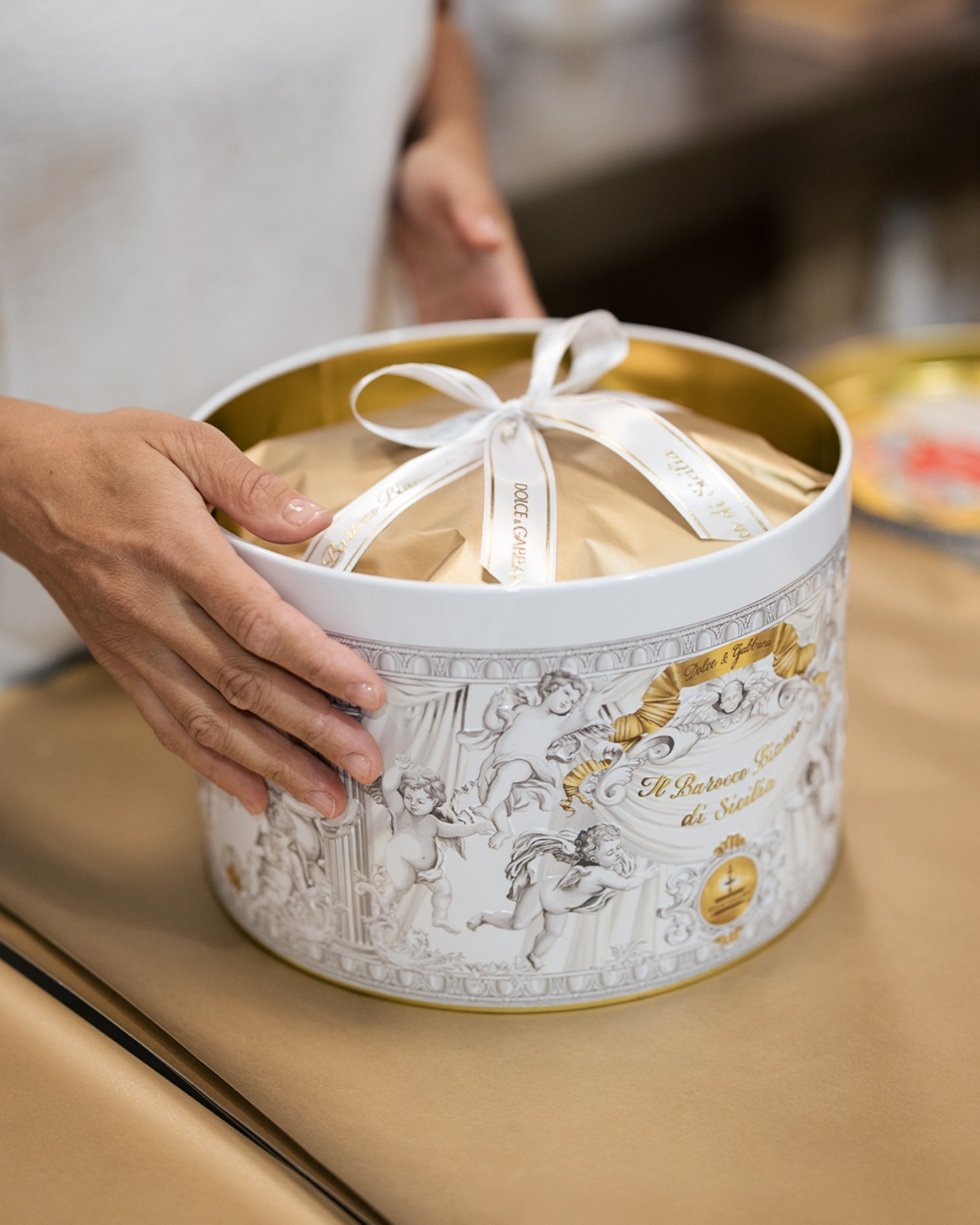
It is precisely in this space that the world of fashion has made its move. When maisons such as Dolce&Gabbana (together with Sicilian master Nicola Fiasconaro), Prada through Pasticceria Marchesi 1824 and the work of Diego Crosara, Gucci Osteria with Massimo Bottura's brigade, Louis Vuitton, Etro (which entrusted its leavened creations to Andrea Besuschio), or Moschino together with the historic Pasticceria Martesana put their name to a panettone, they are not simply selling pastry. They are offering an entry ticket into their own universe at a democratic price. The illustrated tin box or one clad in archive fabrics becomes an object to keep on a bookshelf even after the holidays are over, transforming a perishable food item into a small piece of décor or a collectible.
The Trojan horse of Italian excellence abroad
While panettone was being transformed into a fetish object, something even more significant was happening economically beyond the country's borders. Iconic products of our gastronomy such as pasta, extra virgin olive oil, and wine have for decades had to contend with saturated foreign markets and fierce international competition. Artisan panettone, by contrast, was until a few years ago virtually uncharted territory abroad: international audiences were acquainted almost exclusively with the industrial versions.
When Italy's great leavening masters, from historic figures such as Iginio Massari, Vincenzo Tiri, and Sal De Riso, began exporting the artisan product to New York, London, Paris, and Tokyo, they created an entirely new category of gastronomic luxury from scratch. In international markets, panettone is now presented and perceived through the same lens as Champagne or Parmigiano Reggiano: a complex product, bound to time and human craftsmanship, capable of commanding even higher prices than in Italy and of gradually freeing itself from its association with the Christmas season alone.
Today, a new law establishes that from 2026 only panettoni produced by businesses registered in the craftsmen's register that make the cake directly may be described as "artisan", redrawing the boundaries of a sector that in recent years has attracted an increasingly diverse range of players. It remains to be seen how the market will respond to this new balance between protecting artisan workshops and the desire for collaboration, and what form the next chapter of this leavened cake — now a global cultural phenomenon — will take.