November 19th, 2026
Some Italian proverbs have absurd origins For example, "Things were better when they were worse" has no political origin whatsoever
During a press conference ahead of the 2026 men's football World Cup, held between June and July in North America, Italian coach Carlo Ancelotti — manager of the Brazilian national team — said "If my grandfather had wheels, he'd be a cart": a journalist had asked him whether he would call up Neymar Jr. — the most celebrated player in the Brazilian squad — even if his injury turned out to be more serious than expected. The expression — used to highlight the pointlessness of speculating about hypothetical scenarios far removed from reality — greatly amused those present, and it is not the first time it has met with success and raised laughs in international settings.
The expression is widespread, in various forms, across many regions of Italy — Tuscany in particular — and can sometimes be heard as the equivalent of the more formal "Hindsight is always twenty-twenty". The concept underlying the proverb essentially echoes the Latin principle "Ex falso sequitur quodlibet", according to which any conclusion can be drawn from a false premise, without that conclusion thereby being true.
In Italy the saying has numerous variants, more or less ironic, but it also appears in other languages, including Spanish and Hebrew: such wide distribution suggests that the expression was already known in antiquity throughout the Mediterranean region, and that it has been handed down over time, not least through the migrations that have shaped the European continent.
The origin of "Si stava meglio quando si stava peggio" and "Piove, governo ladro!"
Like the one used by Ancelotti, many Italian sayings have a longer and more complicated history than one might think. Take, for example, the expression "Si stava meglio quando si stava peggio" ("Things were better when they were worse"), used today primarily to express nostalgia for the past and, in some contexts, with a conservative connotation that can imply a form of longing for the Fascist era. Some attribute the proverb to Benito Mussolini himself, who allegedly uttered it in a speech delivered in Turin on 23 October 1932; in reality, the phrase is traced back to the Livorno-born writer Francesco Domenico Guerrazzi (one of the most prominent figures of the Italian Risorgimento), who died in 1873 — more than half a century before the rise of Fascism.
The expression "Si stava meglio quando si stava peggio" became widespread mainly during the 1950s, in an Italy still grappling with the aftermath of war, the rebuilding of cities, widespread poverty, and social tensions. Its meaning, however, is broader and not necessarily political: the saying refers to the tendency to idealise the past, looking back fondly on periods that, while they were being lived through, were anything but easy.
Similarly, "Piove, governo ladro!" ("It's raining — blame the government, those thieves!") has uncertain origins. According to the most widely held account, in 1861 a group of demonstrators had organised a protest in Turin that was subsequently called off due to rain; a satirical newspaper then allegedly published a cartoon accompanied by precisely this phrase. The account has, however, been called into question by subsequent fact-checking: the issue of the magazine to which it is usually attributed contains no such illustration.
The case of "Essere al verde" and "Il fine giustifica i mezzi"
Other expressions, sayings, and proverbs also have uncertain origins, about which several interpretations exist. One example is "Essere al verde" ("To be in the green"), an expression used to mean having no money, which is said to derive from the public auctions held in Florence in the sixteenth century. On those occasions, a candle with a green-dyed base was lit to mark the time available to bidders: when the flame reached the coloured section, no further offers could be submitted. There is, however, an alternative interpretation, which traces the expression to the green baize of gaming tables, which becomes visible once a player has lost all their chips.
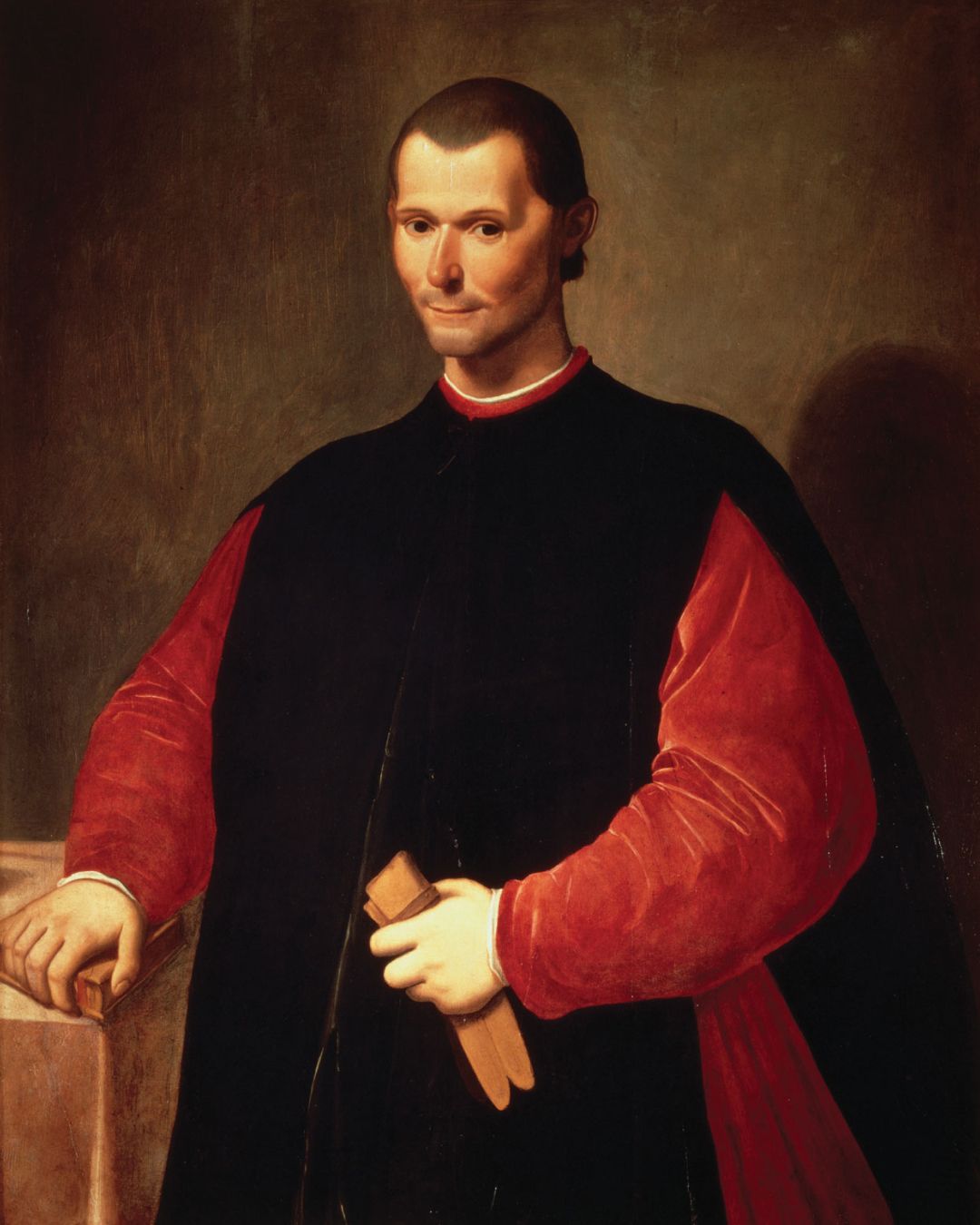
A similar case concerns the proverb "Il fine giustifica i mezzi" ("The end justifies the means"), one of the phrases most closely associated with the Florentine politician and writer Niccolò Machiavelli, who lived between the fifteenth and sixteenth centuries. The expression is said to derive from an interpretation of The Prince, his most famous treatise, dedicated to how power is acquired and maintained, in which he argues that what matters most in the actions of rulers is the outcome. However, a very similar version of the saying appears instead in a moral theology treatise by the German Jesuit Hermann Busenbaum, who lived in the seventeenth century: "Cum finis est licitus, etiam media sunt licita", translatable as "If the end is lawful, so too are the means of achieving it."