November 13th, 2026
Turin's doorways are an open-air museum Turin leaves many doors open onto its own history, and some can be found right before the eyes of anyone walking through the city
The history of a city is not told solely through its monuments, squares, or palaces that end up in tourist guides. In Turin, all it takes is pausing for a few seconds in front of a doorway to find yourself face to face with a piece of history: seventeenth-century superstitions, bourgeois ambitions, Liberty-style experimentation, and more recent architectural visions. Façades often conceal the most interesting details, and it is precisely from here that an itinerary begins through five centuries of Turin's history, following an unusual thread — that of its doors.
Mastio della Cittadella, Corso Galileo Ferraris
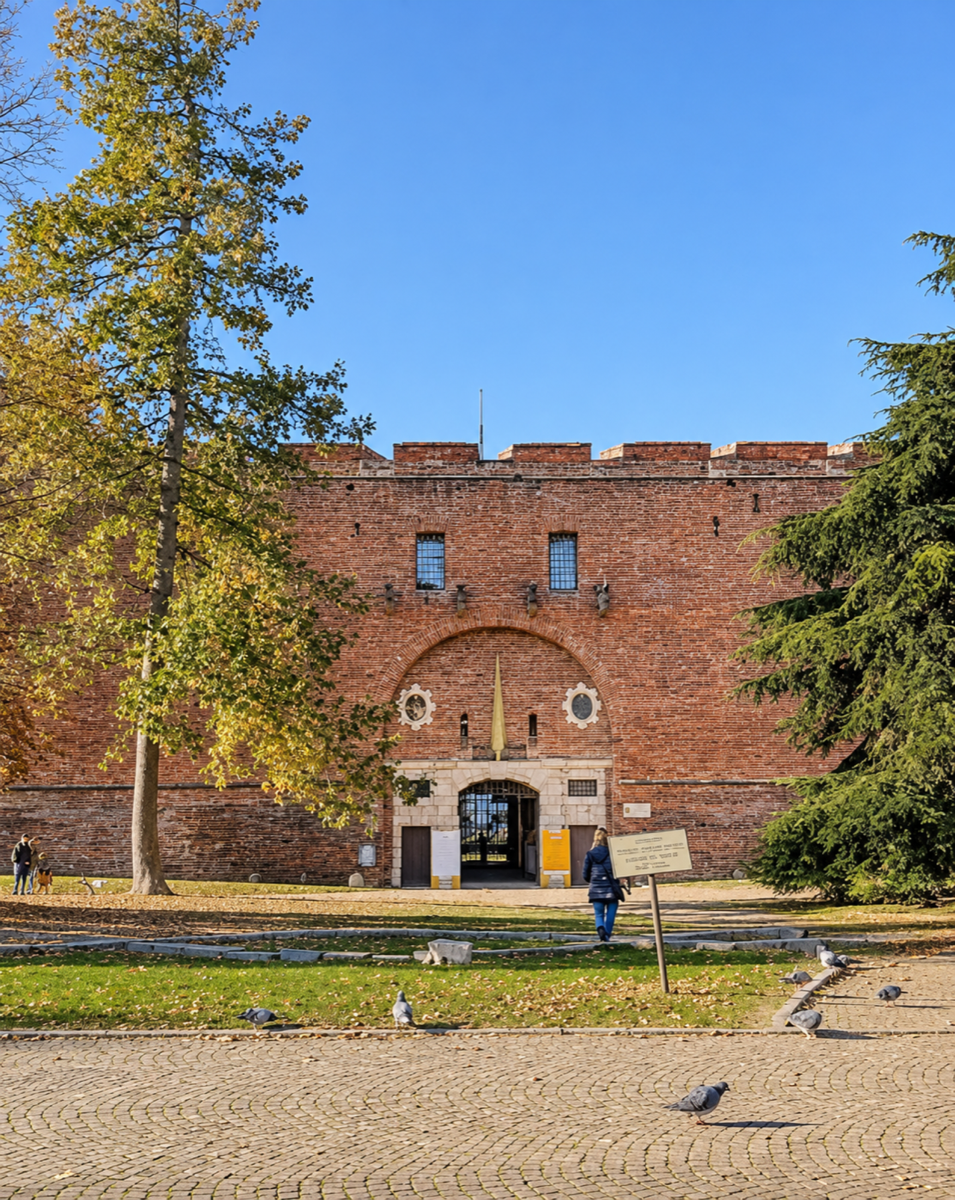
Not all doors are made to welcome: some are designed to keep unwanted guests at bay. Such is the case at the Mastio della Cittadella, where above one of the entrances appears a grotesque mask with a mocking expression, as if laughing at those who allow themselves to be deceived. What looks like a door is in fact a false entrance, designed to confuse anyone attempting to penetrate the fortress. Here, decoration serves not merely an aesthetic function but becomes an integral part of a defensive strategy.
Palazzo Lascaris, Via Alfieri 15
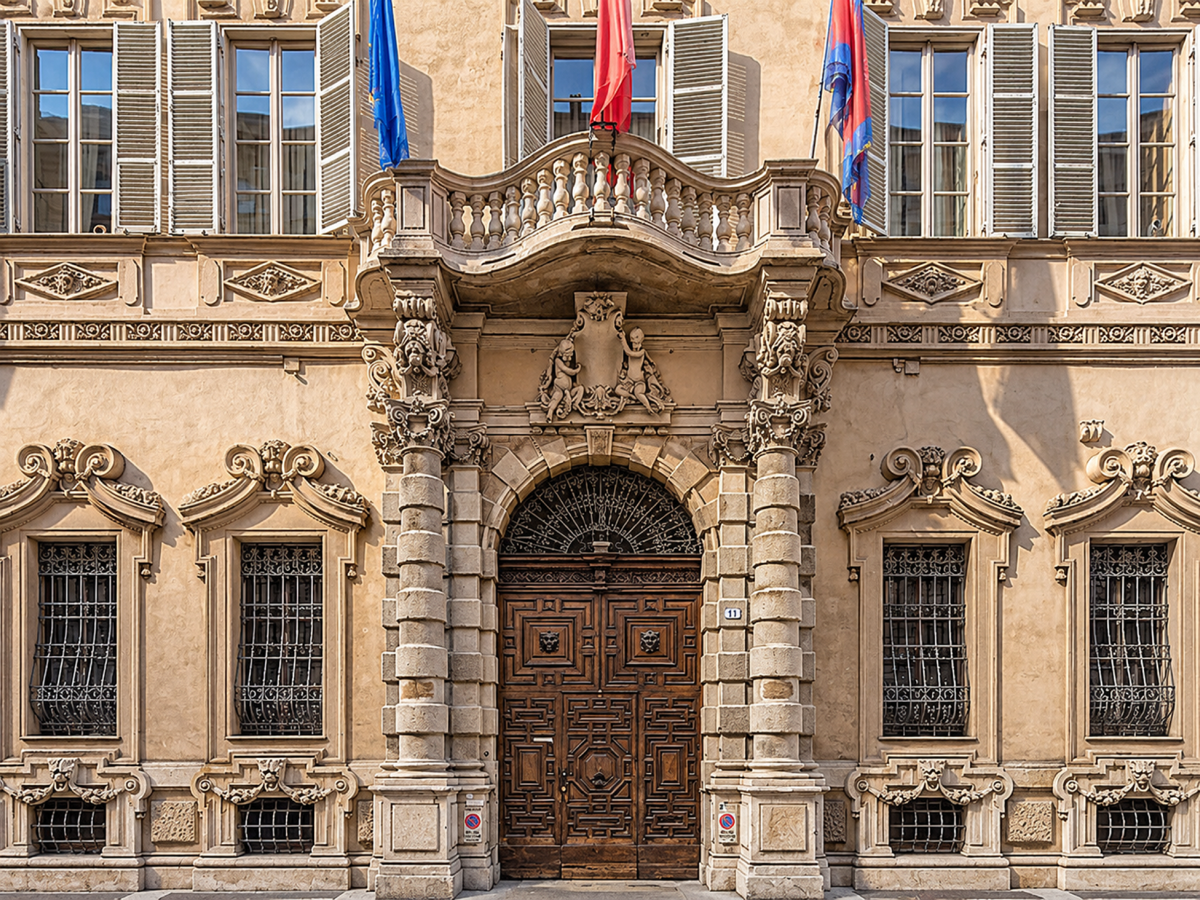
Baroque Turin is often associated with an occult imaginary, filled with esoteric symbols and ancient secret societies. One example can be found at number 15 Via Alfieri, where Palazzo Lascaris stands, built between 1663 and 1665 for Count Giovanni Battista Beggiamo, to a design attributed to Amedeo di Castellamonte. The walnut wood door is decorated with carved panels and grotesque masks — distorted faces that, according to tradition, served an apotropaic function, protecting the house from negative influences. The palace's decorative imagery extends to the façade as well, where mythological figures and faces linked to esoteric symbolism appear, including Hermes, the deity associated with hermetic sciences, and the so-called Green Men, human figures surrounded by leaves and vegetation, connected to an ancient symbolism of rebirth and fertility. According to some accounts, the building is said to have served as the meeting place of a Masonic lodge, whose gatherings supposedly took place in the underground rooms.
Portone del Diavolo, Via XX Settembre 40
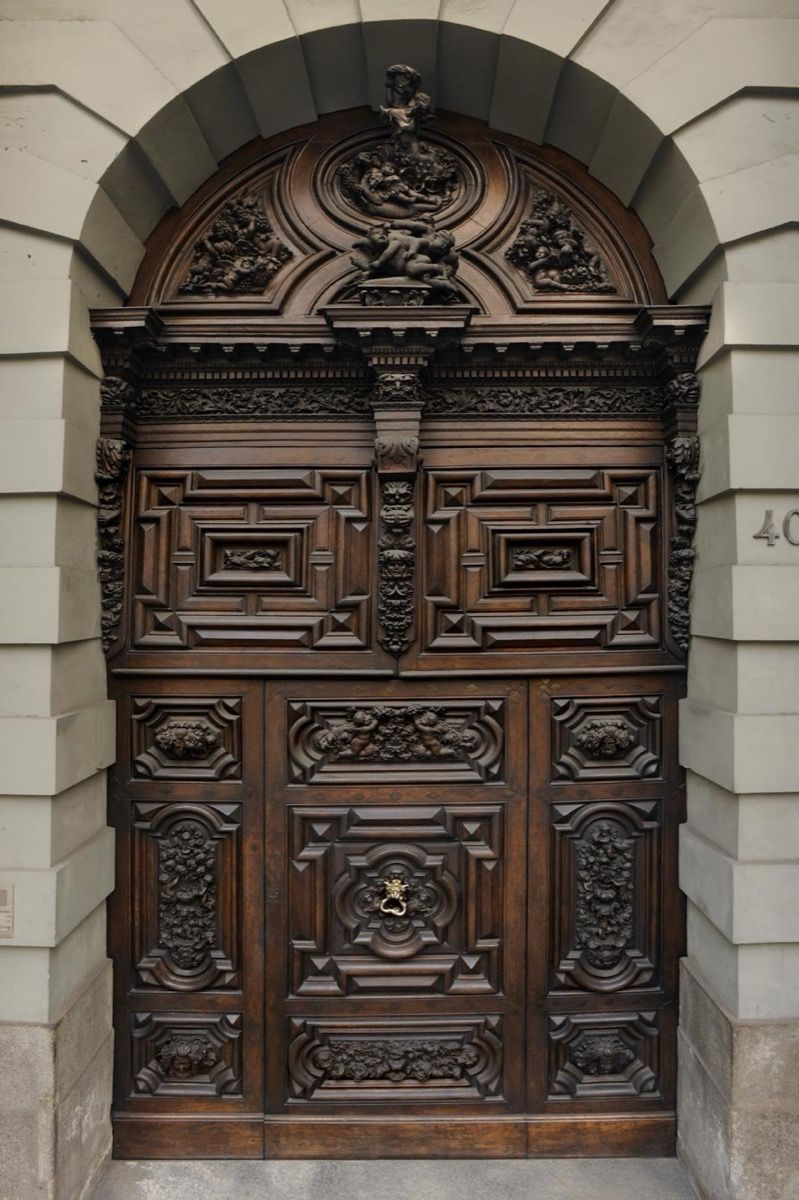
At Via XX Settembre 40, Palazzo Trucchi di Levaldigi houses one of the most singular entrances in seventeenth-century Turin. Built in 1675, the wooden door is richly carved with animals, fruit, and plant motifs, but it is impossible not to linger over the large central bronze knocker depicting a devil. It is precisely from this detail that the legend giving it its name was born: the story goes that a sorcerer's apprentice, trapped inside the palace, invoked the demon to be set free. The devil is said to have appeared on the very door, leaving his face there in bronze. There is no proof that things actually unfolded this way, but the story has helped make this entrance one of the most celebrated and photographed in Turin.
Via Baretti 46
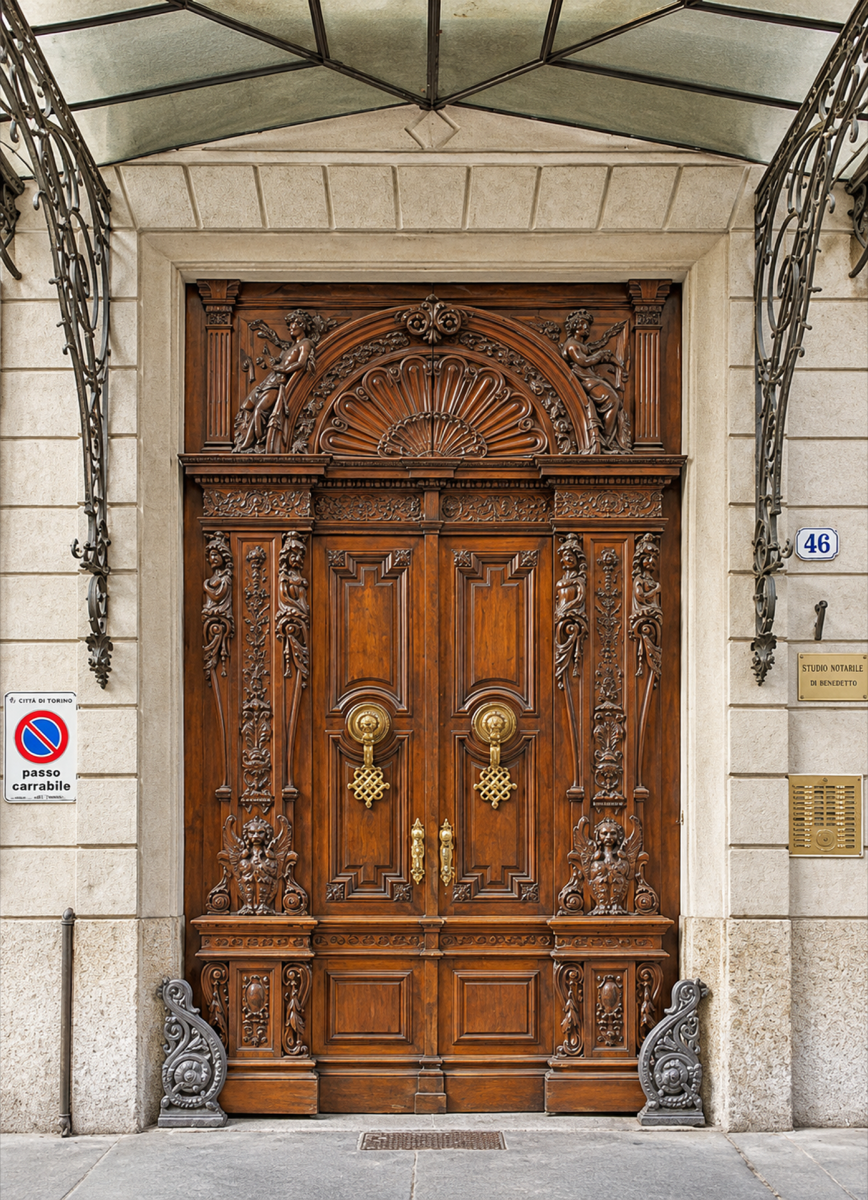
At number 46 Via Baretti stands one of the most elegant entrances in nineteenth-century Turin. What draws the eye above all are the four female figures carved in wood, two on either side of the door and two more in the upper section. These latter figures appear to be engaged in a curious measuring activity: one holds a plumb line, while the other seems to be using a compass on a wooden board. Completing the composition are the lion's-head door knockers, still well preserved today. A small repertoire of figures and instruments that makes this entrance a genuine surprise for anyone passing through the San Salvario neighbourhood.
Palazzo Ceriana, Piazza Solferino 11
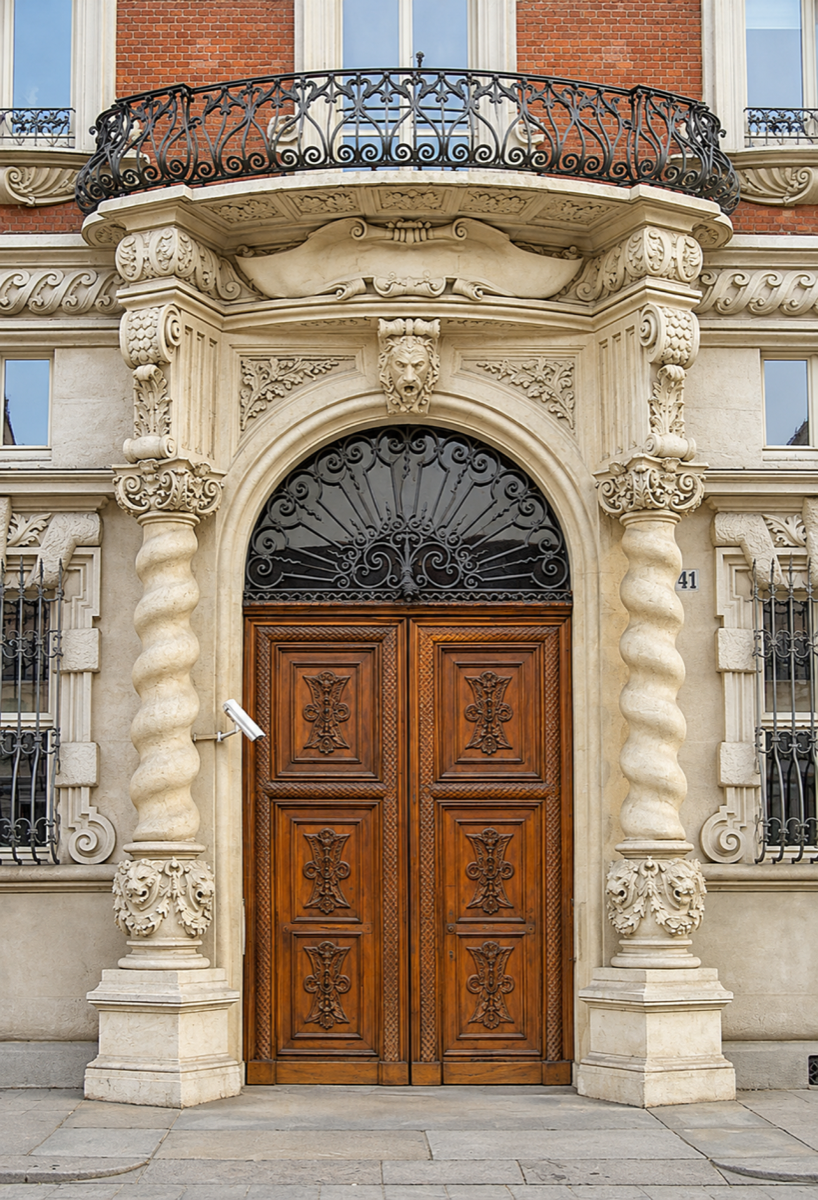
At Piazza Solferino 11, Palazzo Ceriana offers a different example of a monumental entrance. Designed by architect Carlo Ceppi for the Ceriana family, bankers and silk industrialists, it was built between 1870 and 1878 and is distinguished by its eclectic façade, which draws on elements of Baroque Turin. The marble portal is framed by two twisted columns that heighten its theatrical effect and evoke the language of seventeenth-century architecture. Here too, the entrance becomes an integral part of the palace's identity — a tribute to the city's architectural tradition reinterpreted through the taste of the late nineteenth century.
Via Rattazzi 11
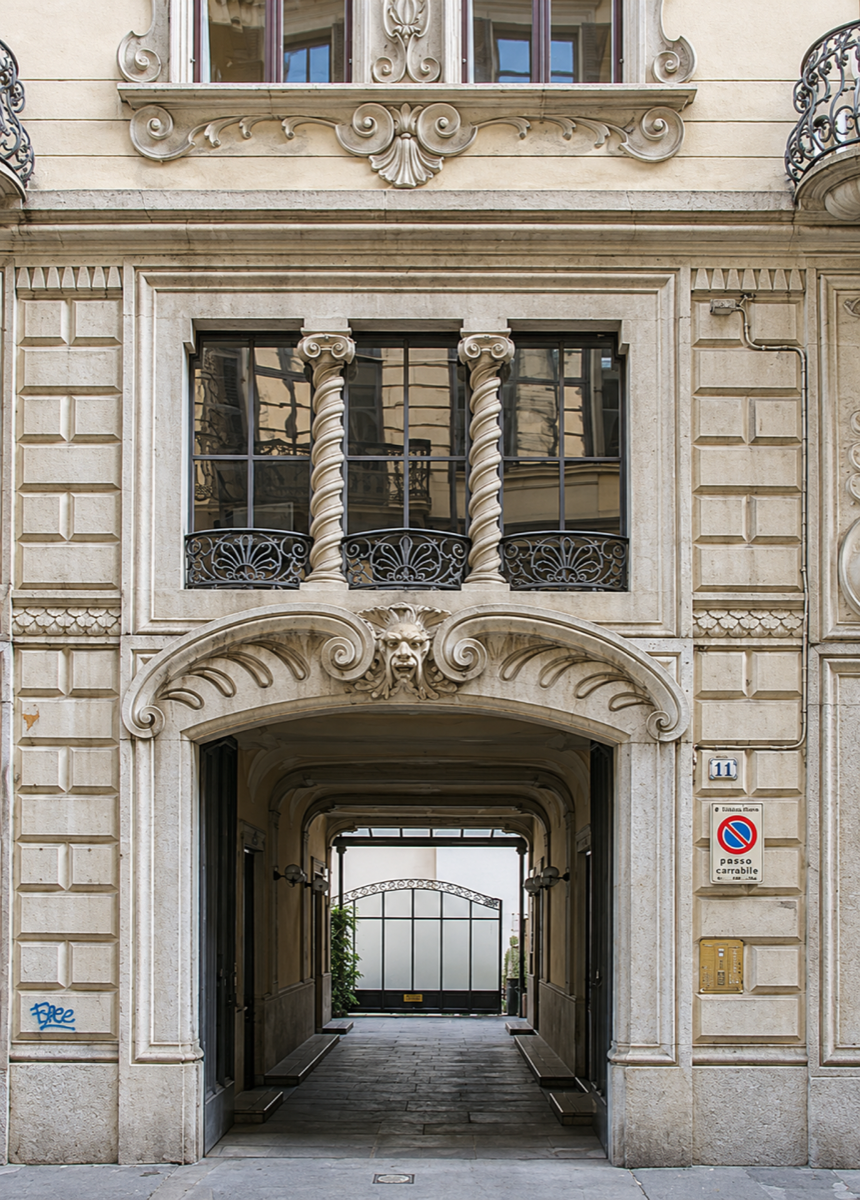
At Via Urbano Rattazzi 11–13, one encounters an entrance of decidedly theatrical appearance. At the centre of the arch, a grotesque mask seems to watch passers-by, framed by large volutes and sculptural decorations. But it is worth crossing the threshold and looking inside as well: the main staircase of Palazzo Priotti unfolds around a broad central opening, with flights of stairs accompanied by wrought-iron railings with floral lines. A scenic ensemble that reflects the eclectic taste of the building, designed by Carlo Ceppi in the early years of the twentieth century.
Casa Fenoglio-La Fleur, Via Principi d'Acaja 11
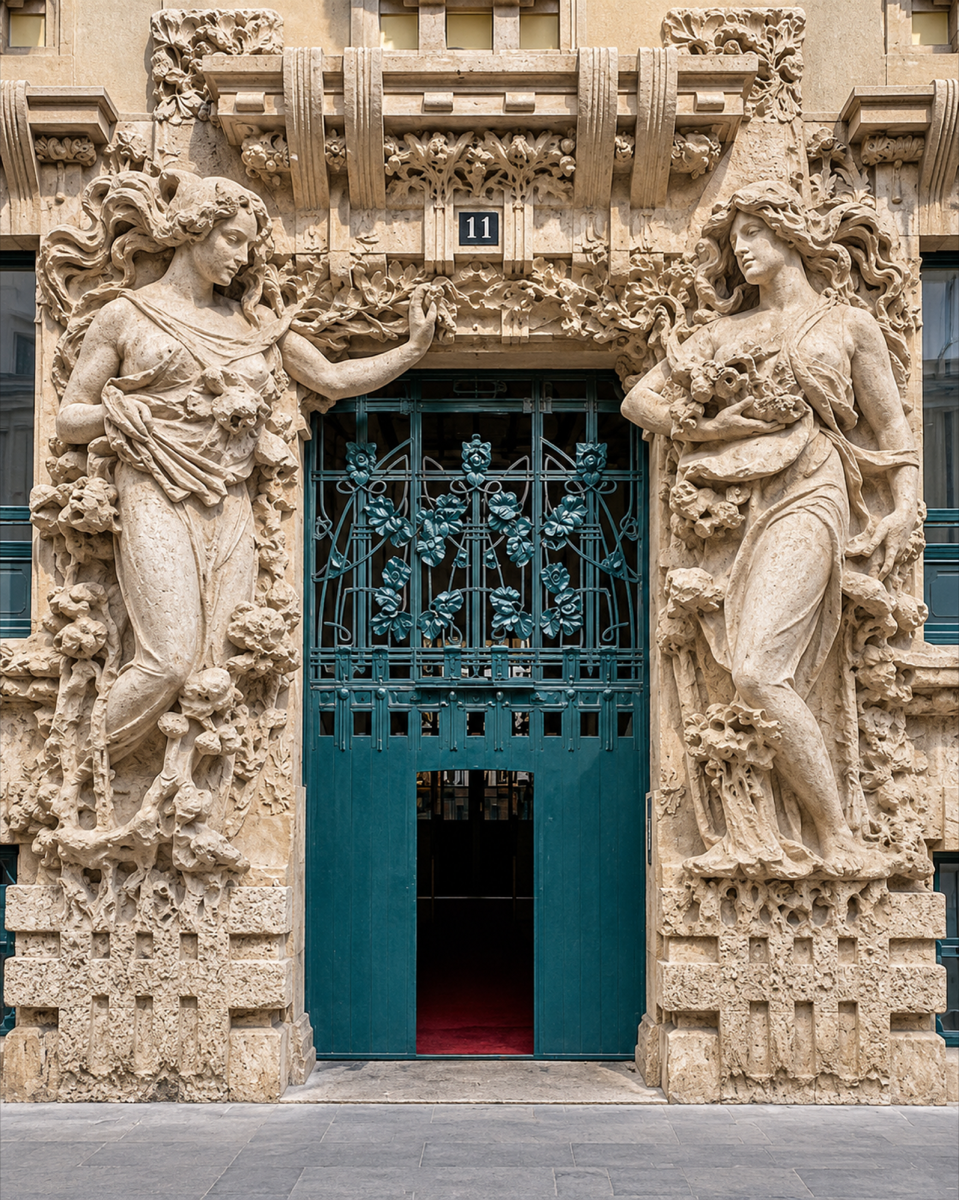
If there is one building that eloquently captures the Turin Liberty style's obsession with detail, it is Casa Fenoglio-La Fleur, on the corner of Via Principi d'Acaja and Corso Francia. Designed in 1902 by Pietro Fenoglio as his own home and studio, it was sold just two years later to the entrepreneur Giorgio La Fleur, from whom it takes its name. Fenoglio did not limit himself to designing the façade: he personally oversaw the interior elements as well, from the entrance door to the brass handles and the cast-iron radiators. An almost obsessive attention to applied arts, in which every detail, however everyday, became part of the architectural design. It is no coincidence that the building is considered one of the defining statements of Turin's Liberty style.
Casa dei Draghi, Corso Francia 23
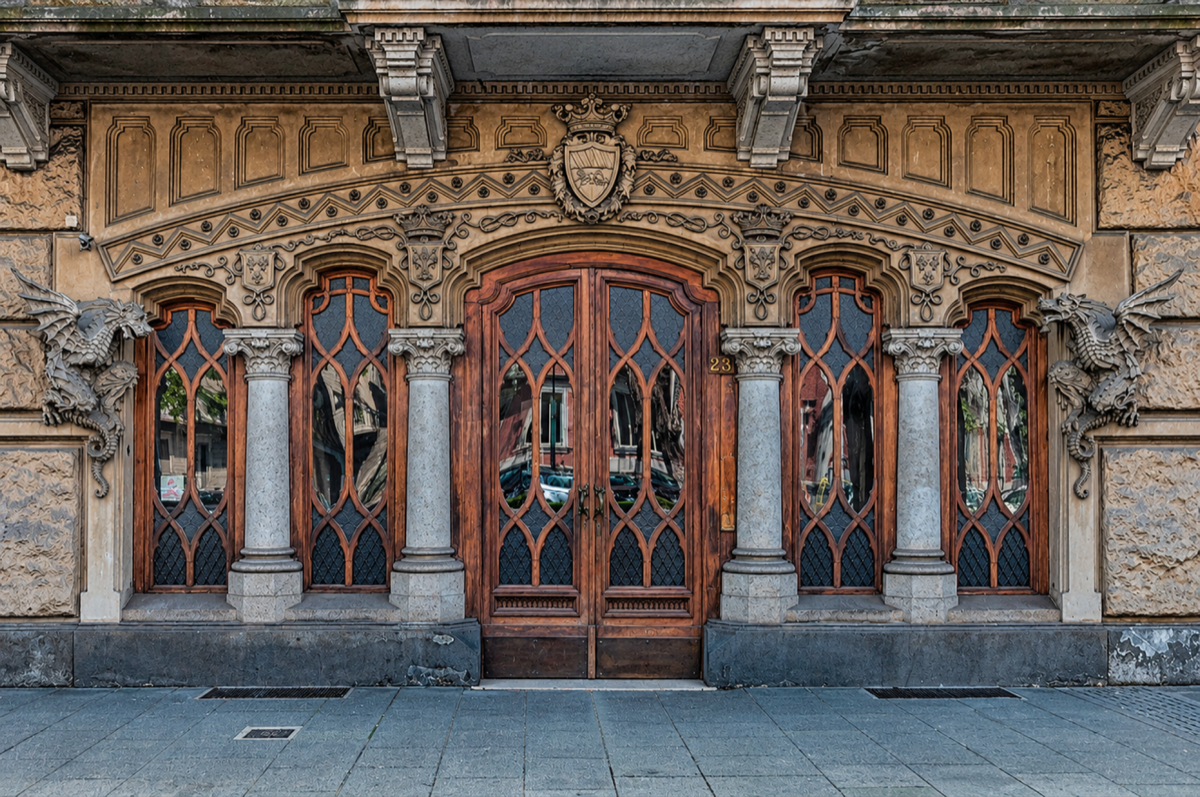
Palazzo Vittoria, also known as Casa dei Draghi — the House of Dragons — after the two winged creatures that stand guard over the doorway, was designed by engineer Gottardo Gussoni and completed in 1922, blending neo-Gothic and Liberty influences. Its entrance looks as though it has stepped out of a Gothic fairy tale: the decorative stained glass offers a glimpse of the interior atrium, while the brass door handles are shaped like two lizards. Completing the scene are the winged dragons on either side and the Carrera family coat of arms above the portal. Its almost cinematic appearance captivated Dino Risi, who in 1974 chose the building as a location for Scent of a Woman, starring Vittorio Gassman.
Portone del Melograno, Via Argentero 4
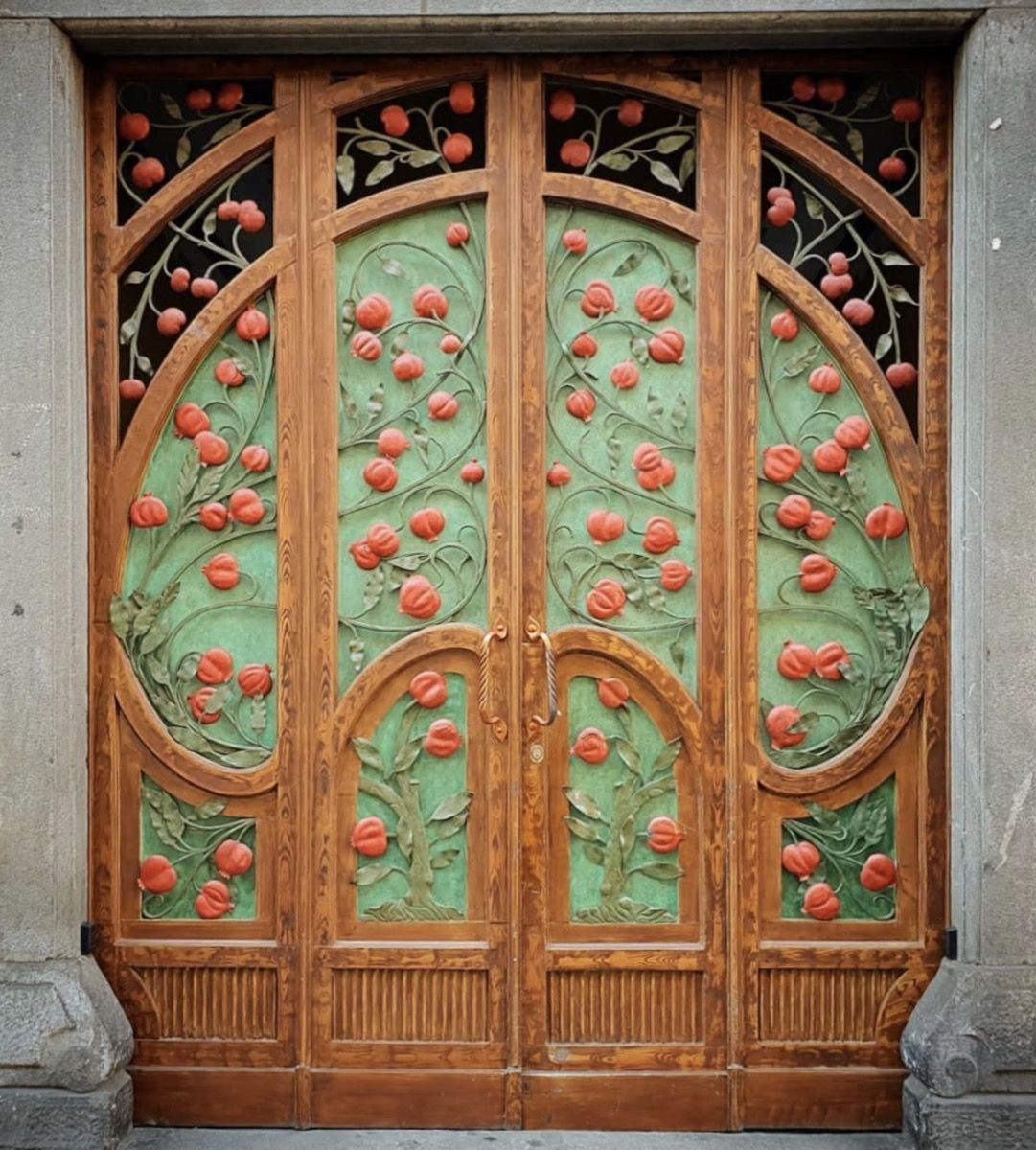
In San Salvario, at number 4 Via Argentero, stands one of the most recognisable entrances of Turin's Liberty style. It is the so-called Portone del Melograno — the Pomegranate Door — designed by Pietro Fenoglio in 1907 for the home of builder Pier Vincenzo Bellia, completed the following year. The two wrought-iron panels are threaded with branches and leaves bearing small fruits, enclosed within a sinuous frame reminiscent of a peacock's tail. The pomegranate, a symbol of abundance and fertility in various traditions, is also one of the most evocative plant motifs to be found in decorative art. For years the door passed almost unnoticed, before being rediscovered and brought back into the spotlight by a restoration that returned to it the vivid colours that make it unmistakable today. A composition in which iron loses its rigidity and seems to transform into a garden.
Teatro Regio, Piazza Castello
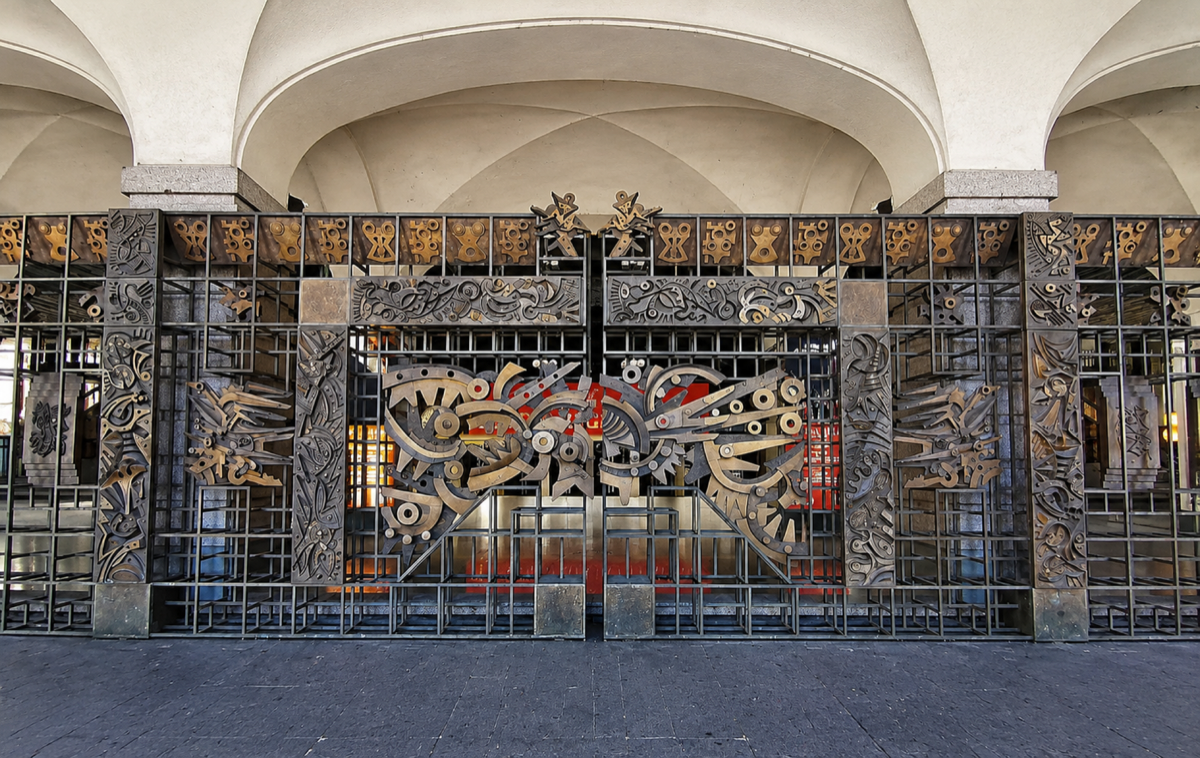
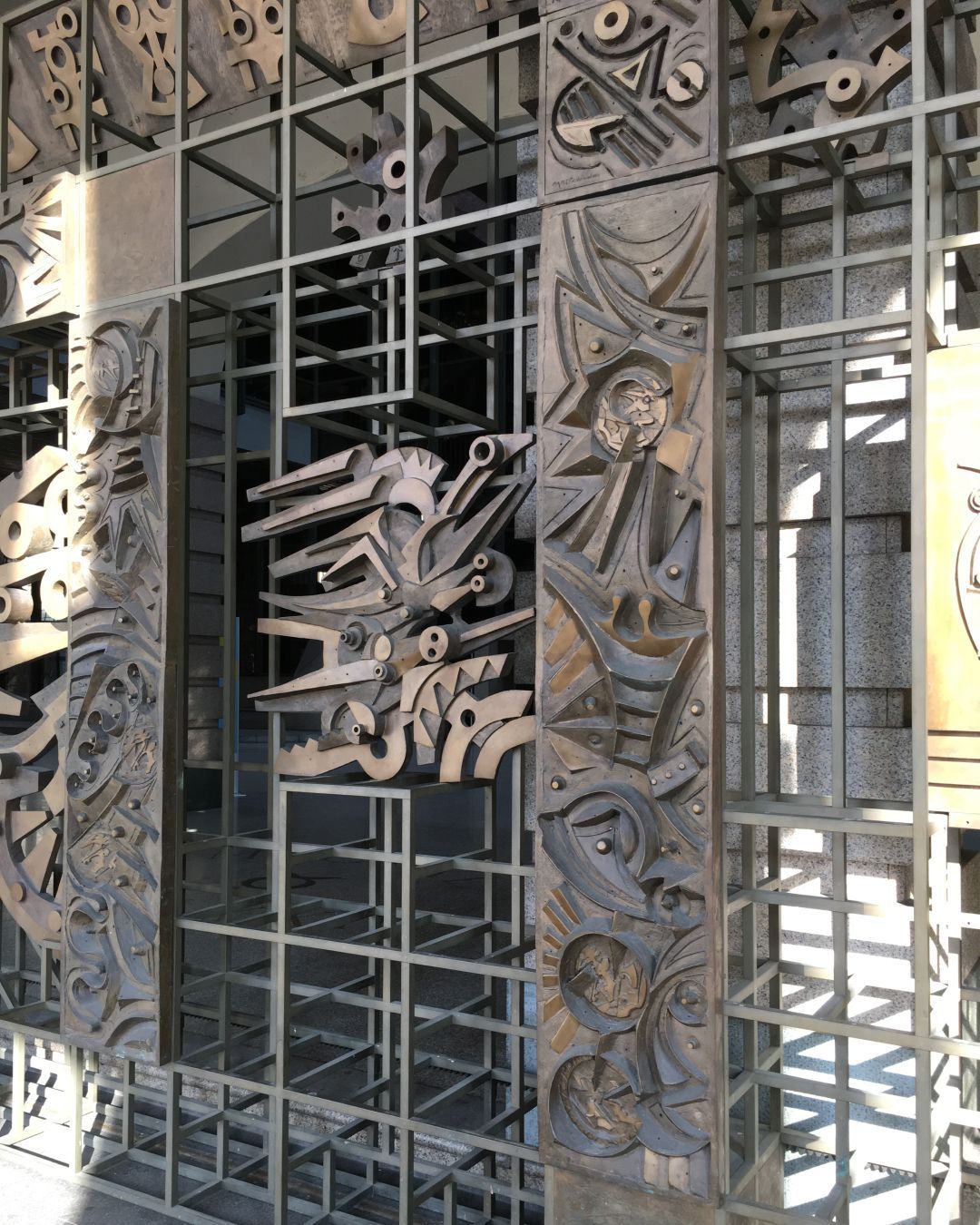
Beneath the arcades of Piazza Castello, the entrance to the Teatro Regio is closed by a large gate that looks almost like a Futurist sculpture. It is called Odissea musicale — Musical Odyssey — and was created in 1994 by Umberto Mastroianni. The work consists of two large sliding bronze panels, divided into squares and tiles of varying sizes, interlocking in an abstract composition inspired by the world of music. It is not merely a decorative element: the gate was commissioned to protect the Carriage Atrium, but has since become one of the most recognisable features of the theatre. It can be seen in its entirety above all during performances, when the panels are opened to welcome the audience.