September 28th, 2026
What happens when an Olympic Village becomes home to 1,700 students? We went inside the Scalo Romana student residence to find out what remains of the Games and what it's like to live in one of Milan's largest university housing projects
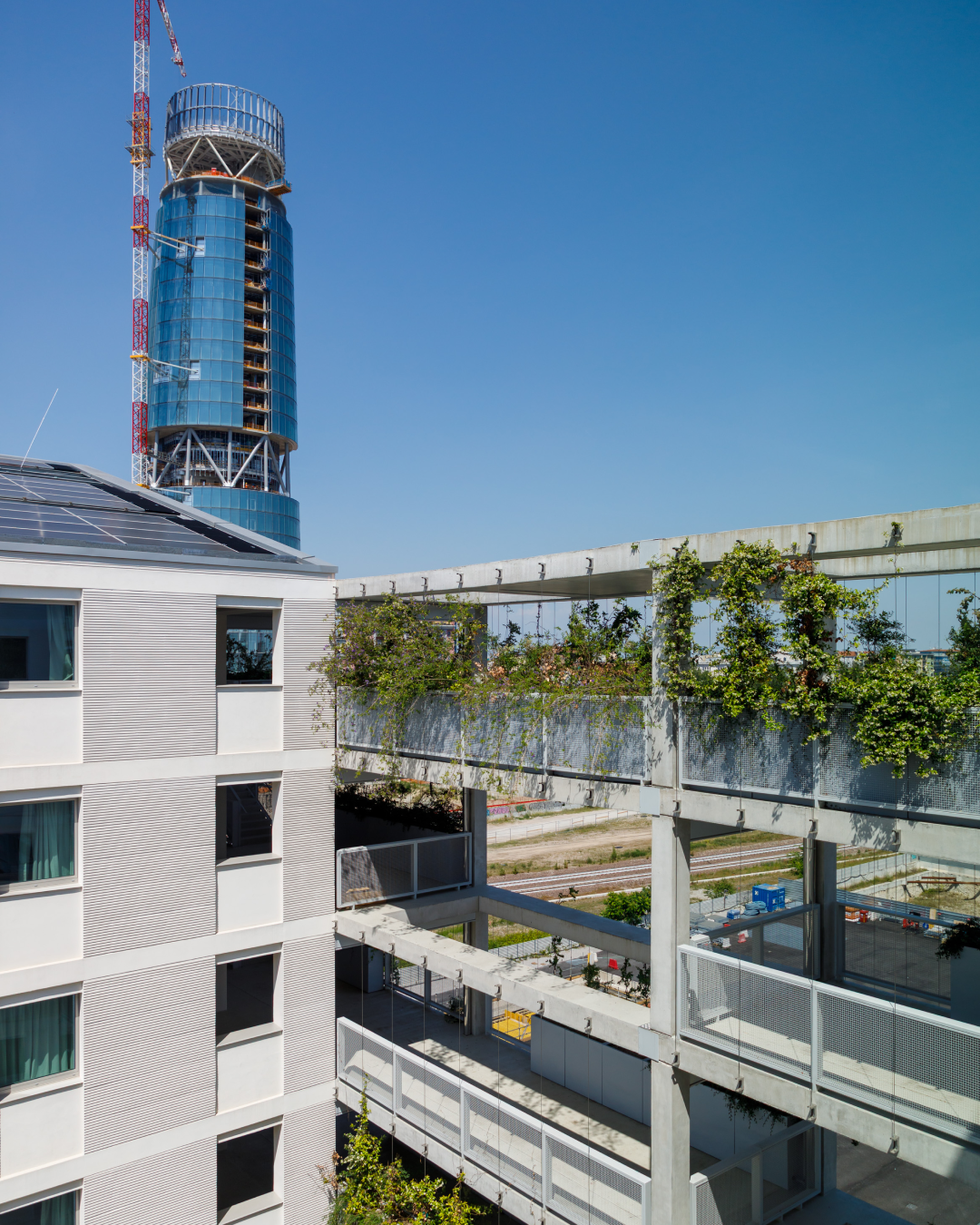
From the outside, the Olympic Village at Scalo Romana conveys a fairly precise impression. The large volumes, the concrete, the sharp lines, and all the activity still swirling around the construction site give it an almost severe, at times sterile appearance. Looking at photos beforehand, we had imagined more or less this: an enormous space, very new, perhaps still too new to feel like anyone's home. Once inside, however, that perception shifts fairly quickly.
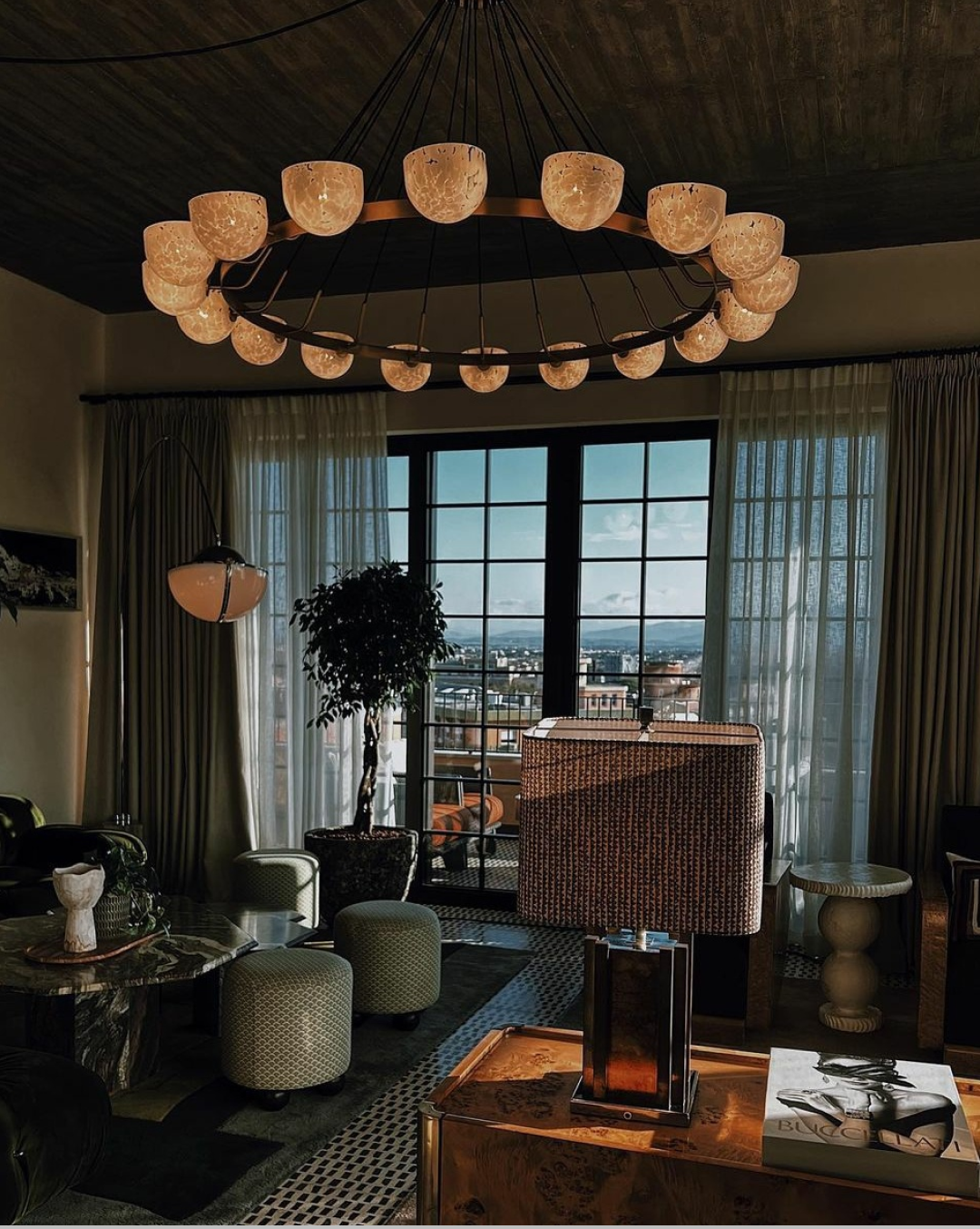
Inside, the language becomes much warmer. Wood, textiles, soft colours, new furnishings, lounges, terraces, study rooms. There is still that characteristic smell of freshly assembled furniture, and in some areas the result is almost reminiscent of a Scandinavian interior. The flags of the Olympic delegations remain on the façades, and outside some rooms the plaques bearing the names of the athletes who slept there just a few months ago are still in place. The Olympics, in other words, have not been erased. They have become a kind of first layer in the history of the place.
What is the new student residence at Scalo Romana like?
The speed with which all this happened had been planned from the very beginning. The Village had already been designed with its second life as a student residence in mind: during the Games, the rooms were fitted with permanent beds, wardrobes, bedside tables and bathrooms, while in the subsequent phase desks, seating and bookshelves were primarily added. Luca Mangia, General Manager of COIMA REM, the COIMA Group company that built the Village, explains that the most significant work of the conversion involved the finishes and, above all, the communal spaces, with the fitting out of more than 40 kitchens and study rooms, the large lounge, the auditorium, the meditation room, the podcast room, the play area and the two gyms. The transition from the Olympic phase to the university phase was completed in around four months.
Today the Village has 1,698 beds and, at the start of September, around 1,300 were already occupied by students from 80 countries. Italians are still the largest group, making up 39% of the total, but the international dimension is perceptible as soon as you begin to walk between the buildings. There are 42 kitchens, 42 study rooms, two gyms, spaces for cinema, music and meditation, sports courts, terraces and areas designed simply for spending time together.
The most successful aspect, at least during a first visit, is precisely this feeling. The spaces seem designed to draw people out of their rooms without forcing them to leave. You can study alone, go to the gym, sit on a terrace, play, cook, watch a Formula 1 race together, take part in a padel tournament or have a barbecue. Security is one of the themes Stefano emphasises during the tour, but what lingers at the end is above all a certain familiarity. After twenty or thirty minutes, the Village already feels considerably less enormous than it does when viewed from outside.
What the students living on campus have to say
Of course, visiting a place and actually living there are two different things. That is why the most important part comes from talking to those who occupy those rooms every day. Beatrice moved in recently and says she immediately felt part of a community. The fact that practically everyone arrived at the same time helped: many people are new to Milan, many are beginning a university journey, and almost everyone seems eager to get to know one another. The shared kitchen has already become part of her daily routine, while in the evenings the communal spaces tend to fill up. The events also surprised her. She had already experienced residences where organised activities were often poorly attended; here, by contrast, she says she saw people genuinely engaged from the very start.
Nicola is in his first year at Bocconi and had worried that having to deal simultaneously with a new university, a new city and a new place to live might make everything more complicated. The study rooms, kitchens and social spaces made it easier for him to settle in, and during Welcome Week he had already had the chance to meet students from various countries, quickly moving beyond the usual circle of people from his own university.
This is also what best brings out the first small frictions of a place that has just opened. The washing machines, he says, are often in use and he would add a few more; he really likes the gym, but thinks it could do with some additional equipment and weights. He has also imagined a kind of student representation, perhaps organised by building, that could collect requests and suggestions and relay them more easily to management. These are not major problems, and he himself describes them as aspects of a facility that is still in its early days, but they are interesting precisely because they begin to move the Village away from the dimension of a perfect project on paper and into the normality of an inhabited place.
Giorgia, on the other hand, comes from a different experience, having already lived in a student residence. What strikes her here above all is the scale. Nearly 1,700 people in the same place means being able to meet students from entirely different universities, courses and nationalities. In her everyday university life she tends to spend time with people from her own course or the same environment; in the kitchens, on the terraces and in the shared spaces of the Village, this barrier becomes much easier to cross.
One of the most interesting observations to emerge from the conversations also came from her: "putting 1,700 students together is not enough to create a community." You need opportunities to meet and activities that genuinely make sense for those who live there. On this very point, Giorgia says she has sensed a strong openness on the part of management, which is keen to understand which proposals might actually work rather than building a calendar of activities entirely from the top down.
How is a community being built in the new student residence at Scalo Romana?
CX Living, which now manages the facility through CX Campus & Hotel, emphasises the same point. Federica Di Fabio, Head of Brand Marketing & Communication, describes the creation of community as one of the central elements of the project, especially in a place where students from different cultures, countries and university backgrounds live side by side. Shared activities and moments serve to create opportunities for encounter, but these first months also have another function: understanding how students will actually use the Village. Their feedback, CX explains, will be used to modify and improve services, timetables, activities and events over time.
Beatrice, for example, still finds the Village slightly isolated from the immediately surrounding life. To find more bars or a livelier atmosphere you need to head towards Ripamonti and Porta Romana, although trams and buses make this fairly straightforward. Giorgia, on the other hand, reads the neighbourhood as a quiet, well-connected area, with essential services already nearby and the option of getting around easily by bike as well. Nicola walks, cycles or takes the tram to Bocconi and says he has found it easy to get around the neighbourhood in the evenings too.
The Olympic Village at Scalo Romana and the regeneration of southern Milan
The student residence is already practically a small university town, while Scalo Romana is still a part of Milan in the midst of full transformation. COIMA envisions the Village as the future "young heart" of the new neighbourhood. In the coming months, the ground floors of the new buildings and the refurbished historic structures, such as the Squadra Rialzo and the Basilico building, will progressively house shops and services, while the broader regeneration project for the Scalo will continue to take shape around them. The area will be completed with residences, businesses, services and a large public park.
This is also the level on which Milan's Deputy Mayor Anna Scavuzzo focuses. For the City, the student residence represents both an opportunity for students from outside Milan and for a neighbourhood that is changing its identity. The Integrated Intervention Plan covers the entire former railway yard and envisages, over the coming years, open-market, social and subsidised housing, commercial and tertiary functions, a large park and new cycling and pedestrian routes. Scavuzzo places this transformation within a broader area that already includes Fondazione Prada, Symbiosis and Torre Faro, and which, in the administration's intentions, is moving from a former industrial zone to a multifunctional district.
The university presence is part of this process. The Deputy Mayor highlights how the promotion of university and post-university residential living is one of the elements the City is working on in other Milan transformations as well, from Bovisa to Greco-Breda and the former Macello. The idea is that a person can come to an area of the city to study and, once that journey is complete, find the conditions to continue living in Milan.
The future of the Olympic Village after Milan Cortina 2026
Today, however, you only need to step outside the Village to understand that this part of the story has yet to be written. Inside, there are already students cooking together, studying, doing sport, organising activities and beginning to build their own routines. Outside, there are still construction sites, spaces that have yet to change their function, and a neighbourhood that will look very different in the years ahead.
Perhaps it is precisely this contrast that makes visiting the Village interesting today. You go in expecting a place still suspended between the Olympics and the future, and you find a facility that has already begun to have a daily life of its own. The project is new, the furnishings are still new, various balances have yet to be struck, and other needs will inevitably emerge. It would be strange if they did not.
For now, the issues described by students are very concrete and almost domestic: a few more washing machines, a gym to be completed, a more direct way of communicating with management. At the same time, the same words keep coming up: people, communal spaces, encounters, security, openness.
During the tour, that sterile feeling that the architecture might suggest from a distance does not emerge. Almost the opposite happens. The Village already seems to be succeeding in sheltering a small everyday life while everything around it continues to change. The traces of the Olympics will probably remain for a long time yet. The flags on the façades, the athletes' plaques, the photographs and the memories of those months are now part of the place. But the real test has begun now. The hardest part — the part that cannot be fully planned — falls to the nearly 1,700 people who will have to transform these spaces into habits, relationships and memories. In just a few weeks, something has already started to happen. The rest, inevitably, will be made by the students.