July 14th, 2026
Luxury hotels have a soft spot for voyeurism When the bedroom is no longer a refuge but becomes a set
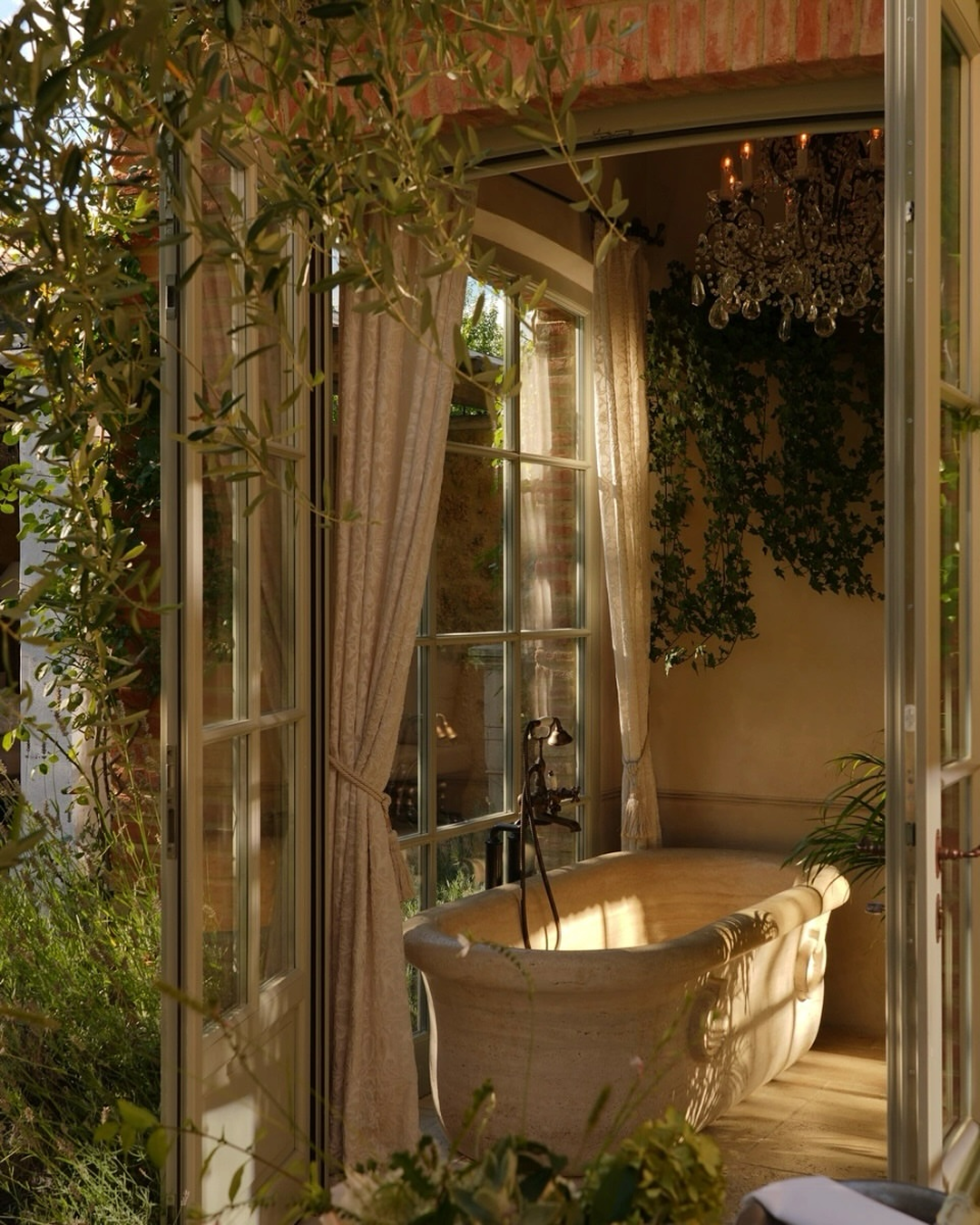
There’s something rather absurd that seems to happen more and more often the moment you walk into a hotel. The room is beautiful, the lighting is perfect, the bed is enormous, the view is stunning, the minibar looks like a small altar to contemporary consumerism, the bathroom is clad in marble, and the bathtub sits in the middle of the room like a sculpture. Then, after a few minutes, you realize that the room isn’t really designed to hide you. It’s designed to make you visible.
The shower is enclosed by a glass wall, the toilet has a sliding door that never really closes, the bathtub sits beside the bed, and the sink has become another piece of bedroom furniture. Sometimes it's even subtler: a floor-to-ceiling window overlooking the city, curtains that never quite cover everything, a bathtub facing a window, an overly exposed terrace. Privacy doesn’t always disappear dramatically. More often, it simply becomes thinner, more theatrical, treated as a detail worth sacrificing in the name of light, space and experience. Today, part of the hospitality industry—especially the more design-oriented side of it—seems to be moving in the opposite direction. Hotels are no longer creating rooms that shield us from view, but spaces where even intimacy becomes part of the atmosphere.
Why more and more hotels are giving up on privacy
@erikatitus so fancy
original sound - Erika
The clearest example is the bathroom. Over the past few months, the topic has sparked something close to an online revolt, with guests arriving at their rooms only to discover bathrooms without proper doors, frosted glass panels, curtains, sliding dividers and walls that let sounds, smells, shadows and awkwardness seep through. Both The Guardian and the Wall Street Journal have described this trend as the result of aesthetic choices, cost-cutting measures, smaller rooms and easier maintenance. But for travellers the issue is much less theoretical: sharing a room is one thing, sharing every single bodily function is another.
The problem doesn't only affect couples. If anything, it becomes even more obvious when you're not travelling with a romantic partner. If you're sharing a room with a friend, a colleague, a parent, a sibling—or simply someone in front of whom you’d rather not turn using the bathroom into an exercise in mutual trust—that glass wall stops looking cool almost immediately. It’s no longer design; it’s panic. It’s no longer minimalism; it’s an awkward conversation you have the second you walk into the room.
More and more hotels have bathrooms without doors
It’s no surprise that someone eventually launched Bring Back Doors, a website that ranks hotels according to the level of bathroom privacy they offer. It may sound funny, but it also says a lot: we've reached the point where, before booking a room, you have to check whether there's actually a proper door. The website categorizes hotels into almost comically precise groups: full privacy, partial privacy and zero privacy. In other words, something that used to be taken for granted has become just another booking filter, like complimentary breakfast or proximity to the subway.
What's interesting is that hotels rarely present this loss as an actual loss. Instead, they describe it using soft, reassuring language: open-plan, spa-like, seamless, sensory, immersive. Bathrooms flow into bedrooms because it makes everything feel bigger, brighter and more fluid. Bathtubs are no longer hidden because they're meant to become objects to admire. The shower is no longer just a shower—it becomes a carefully staged experience, where the body is no longer left alone but incorporated into the set.
Outdoor resort showers work in exactly the same way. On paper, they represent ultimate freedom: water, sky, plants, stone, wood, wet skin and nature. In reality, they're one of the most carefully controlled devices of contemporary luxury. Nature is there, but it's domesticated. It feels as though you're outside, but you're still inside a carefully designed perimeter. The plants provide cover—but not too much. The walls offer protection—but still allow you to feel slightly exposed. It's safe, curated, expensive nudity. You're never truly vulnerable, but for a few moments you get to play with the illusion of being so.
Luxury hotel design between aesthetics and voyeurism
@suitelifestudios with breath taking views of NYC and the Hudson River. The Standards Liberty Suite is a top pick for our Suite Life reccomended stays Would you stay here ?! #nychotels #staycation #hotelroomtour #visitnyc #thestandard #highline Life Is Beautiful - Larry June & 2 Chainz & The Alchemist
The same dynamic plays out with large windows. The Standard High Line in New York remains perhaps the most famous example because it pushed this ambiguity almost to its breaking point. The hotel proudly states that all 338 rooms feature floor-to-ceiling windows overlooking Manhattan or the Hudson River. It's undeniably spectacular. But as Metropolis Magazine has pointed out, those same windows have turned the building into an almost perfect case study of urban voyeurism: guests inside watch the city while people outside can watch them in return. The room becomes a stage suspended above the High Line, where privacy depends entirely on whether someone remembers to draw the curtains.
None of this is necessarily wrong. It would be too simplistic to argue that every glass wall is a problem or that every bathtub in the bedroom is ridiculous. Some of these solutions are genuinely beautiful, and some rooms work precisely because they redefine the relationship between the body, architecture and landscape. The real question is who gets to decide the level of exposure.
When hotel design becomes a problem
@sofimanassyan Why is there always glass? #sofimanassyan #relatable #funny Be My Baby - The Ronettes
Because luxury should mean choice, not obligation. If I book a suite with a bathtub in the middle of the room, I'm choosing a certain vision of a holiday. But if I unexpectedly find myself with a semi-transparent bathroom that was never clearly advertised, I'm living with someone else's design decision. That's the real difference. Design can certainly play with intimacy, but it should always leave an escape route. A proper curtain. Glass that turns opaque. A door that actually closes. A separation that is more than just a promise.
Maybe that's why the topic is both hilarious and infuriating at the same time. A bathroom with a glass door is the perfect running joke, but it's also a small betrayal. Because paying for a hotel room means paying for a promise: for a few hours, that space belongs to you. You should be free to leave it messy, to be uninteresting, unseductive, unpresentable. You should be able to shut the world out. Perhaps the real luxury this summer isn't a bathtub facing the sunset, an outdoor shower beneath the stars or a glass wall overlooking the skyline. The real luxury is being able to decide when you want to be part of the scene—and when you don't. To be visible only if you choose. To open the curtains only if you feel like it. To close a door and know that, for at least a little while, nobody has to see anything.