November 18th, 2026
In Italy, people spend their lives riding scooters Some use it to go to school, some to meet up with friends, and some remember it as the star of their summers
In Italy, there is one object that accompanies us through the different seasons of life more than any other: the moped. At 14, the craving for freedom that comes with adolescence arrives, along with the first requests to parents for permission to get a licence. At 16, distances start to shrink and a personal geography takes shape, made up of places to reach and people to meet. Between a "I'll come pick you up outside your place" and a trip to the seaside on the hottest days, the moped remains a constant presence through university years too, eventually becoming the vehicle used to navigate traffic and arrive at the office on time, especially when the alarm clock struggled to be heard. Then, almost without noticing, the forties arrive and your most loyal passenger becomes your child, to be dropped off at school every morning. What at fourteen represented a conquest of independence has, in the meantime, transformed into a practical solution for getting around the city, through traffic and the ever-expanding restricted traffic zones.
The distinctly Italian passion for two wheels is not merely a matter of memories. According to the Italian Statistical Yearbook 2025 by ISTAT, in 2024 3.3% of employed people used motorcycles and scooters to get to work, compared to 1.6% of students who chose them to travel to school or university. A difference that reveals how the relationship with two wheels is not the exclusive domain of teenagers, but evolves alongside the habits and needs of those who ride them. Looking at daily commuting patterns, another interesting figure emerges: according to surveys by the Audimob Observatory at ISFORT, in the first half of 2025 motorcycles accounted for 4.5% of all journeys, compared to 3.5% recorded in the same period the previous year. The car remains the dominant mode of transport, but two wheels continue to carve out a well-defined space in the country's mobility landscape.
When the moped stops
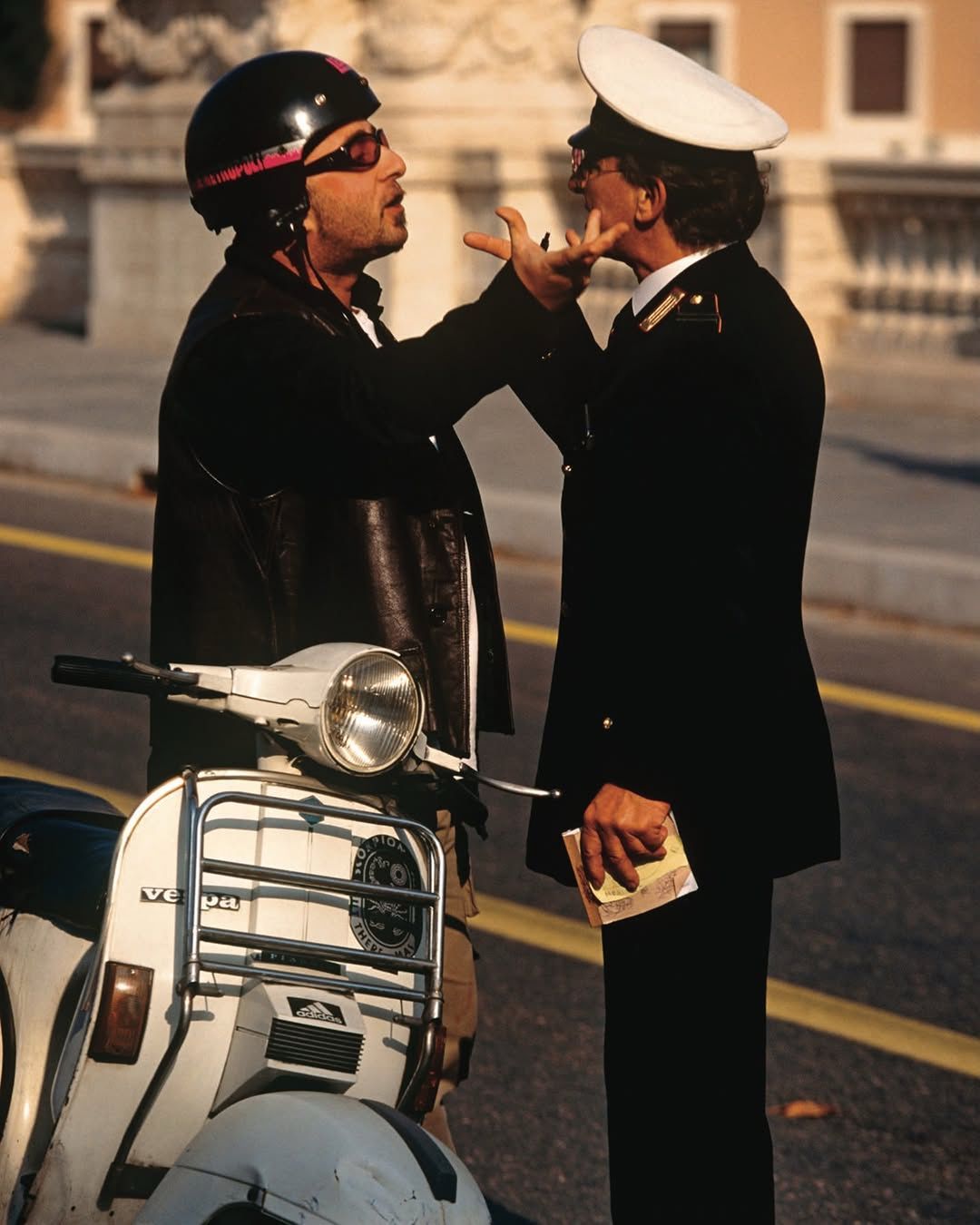
The wonderful thing about the moped is that, for Italians, it represents not merely a convenient and fast means of transport, but also the natural backdrop to some of the most important moments in life. After all, the Bel Paese is dotted with extremely narrow streets that are almost impassable by car, which often make two wheels a necessity. But what happens when the moped stops? Not when you run out of petrol, but when it's parked outside a bar and, finding no room among the tables, ends up serving as a leaning post for an evening of conversation; or when, after a bad argument, you spend hours leaning against someone's moped outside their building, waiting for the right moment to apologise. The moped thus becomes a kind of pseudo-third place, a space that is not quite a place in its own right, yet ends up serving the same function: a meeting point capable of bringing together friends and, sometimes, complete strangers.
This social dimension fits into the increasingly pervasive presence of two wheels in the daily lives of Italians. According to ISFORT's 22nd Report on Italian Mobility, in 2024 the Italian vehicle fleet included approximately 7.7 million motorised two-wheeled vehicles, a figure that has nearly doubled since the early 2000s. This helps explain how the moped is not merely a nostalgic object, confined to the imagination of those who grew up between the eighties and the noughties, but a vehicle that continues to hold an important place in everyday life, even for younger generations.
The moped in cinema and music
Over the years, Italian cinema and music have frequently chosen the moped as a narrative device, precisely because of its ability to capture moments and snapshots of life that can be vastly different from one another. Few vehicles have managed to convey an intimate relationship with one's city quite like Nanni Moretti's Vespa in Dear Diary, through which the director travels across Rome, observes its neighbourhoods and narrates the city from his own perspective. In music, one need only think of 50 Special by Lùnapop, which turned a small-engined scooter into an image of adolescent freedom, made up of hills, unplanned afternoons and that feeling of being able to go anywhere, even without a precise destination. Two very different portrayals, yet both restore to the moped the same value: that of a vehicle through which to observe the world and build one's own relationship with everything around us.
Even before being a means of transport, the moped has been a rite of passage, a rendezvous, a companion, a first taste of freedom. Sometimes it serves to escape, other times to meet up, to while away the hours or simply to see the world from a different perspective. And perhaps it is precisely this ability to change its meaning alongside those who ride it that makes it, even today, something more than a simple way of getting from one place to another.