November 6th, 2026
Do We Need Sfera Ebbasta to Get Young People Into Museums? Rap music could become a way to bring new generations closer to art
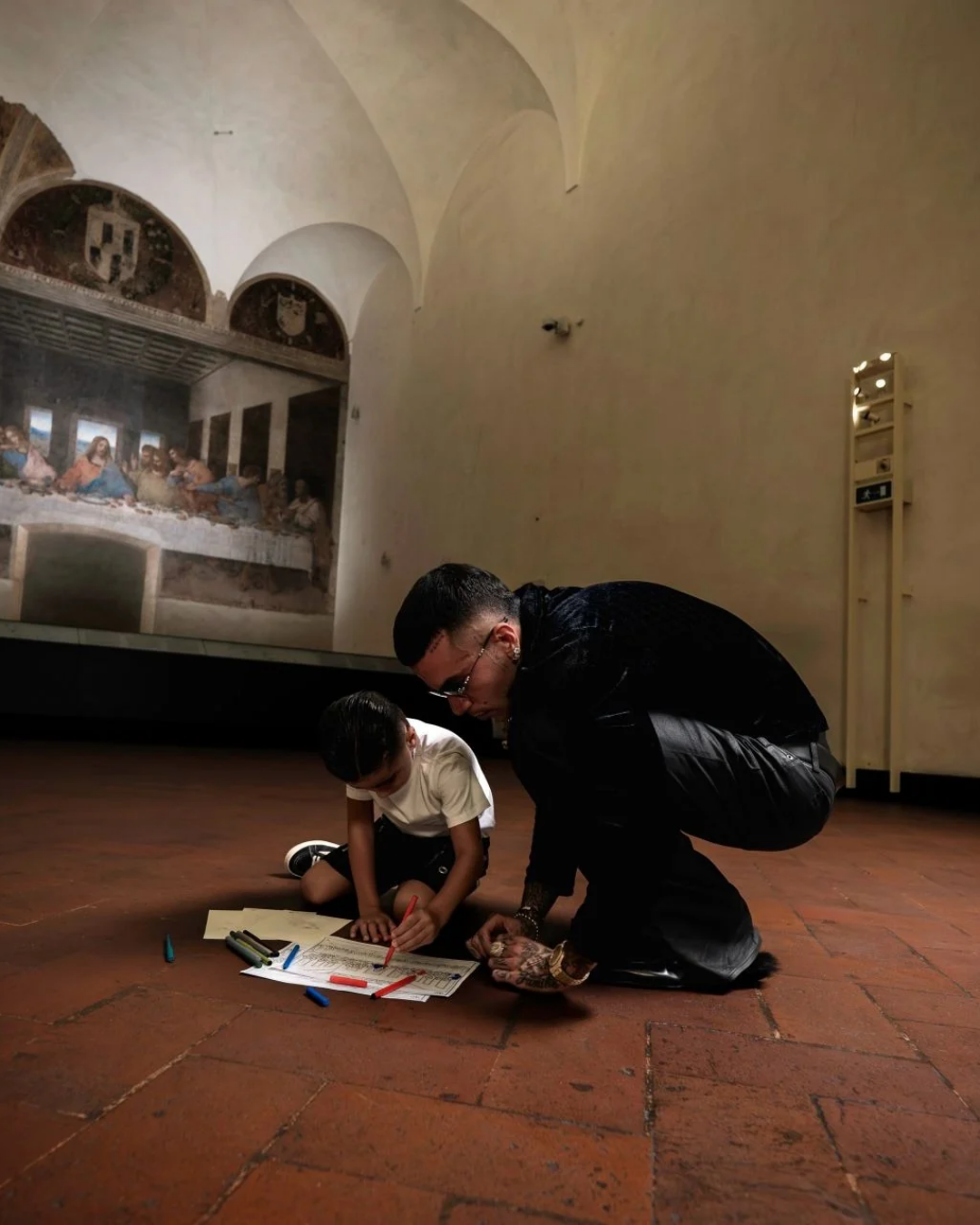
Sfera Ebbasta entered the Cenacolo Vinciano in Milan to shoot the music video for Lontano, accompanied by his son Gabriel, in front of Leonardo da Vinci's Last Supper. But the collaboration with the museum didn't stop at the filming. The rapper helped organise three special openings, on November 5, 8 and 13, dedicated to students, young people involved in social inclusion projects, and young patients from Niguarda Hospital. An initiative that brings rap music into one of the most important sites in art history, giving younger generations the chance to experience it up close.
The first event involved around thirty students from the Istituto Comprensivo Piazza Costa "Morandi" in Cinisello Balsamo, the same school Sfera attended as a teenager. With selfies, autographs, and a guided account of the work by Angelo Crespi, director of Grande Brera, the students had the chance to meet the rapper and observe one of the most famous paintings in the world. The upcoming visits will involve groups supported by the association I Bambini delle Fate and patients from Niguarda's Paediatrics ward. For many young people, meeting an artist they follow through music can also become an opportunity to discover something they had until then only seen in books or on a screen.
Are young people really so far from art?
When discussing new generations, there is a tendency to speak of a progressive loss of interest in culture. Yet the numbers paint a different picture. According to the Federculture 2025 Report, young people between the ages of 6 and 24 show levels of cultural participation that are on average around ten percentage points higher than the general population. Significant disparities in access remain, however, particularly between Northern and Southern Italy, where attendance at museums and exhibitions shows gaps of up to around 15 percentage points.
Interest in art, then, does not appear to have disappeared. If anything, the way people encounter it has changed. Today, a work of art can become the backdrop of a music video, circulate on social media, or be reinterpreted through digital illustration, animation, and other creative languages. Recognising a work, however, does not necessarily mean knowing its history. And between a photograph seen on Instagram and a visit to a museum, there can be very real obstacles — from geographical distance to financial constraints, to a simple lack of opportunities to engage with certain cultural environments.
The art market, too, tells the story of a generation less distant than one might think. According to the Art Basel and UBS Survey of Global Collecting 2026, Gen Z collectors surveyed are those who spend the most on average on works of art, surpassing previous generations. The data concerns 3,100 collectors with significant wealth, however, so a very specific segment of the young population. It nonetheless demonstrates that the relationship with art can take many forms — from simple curiosity to collecting — without necessarily following traditional paths.
From the music video to the chance to discover Leonardo
The decision to shoot a music video in front of the Last Supper had sparked some controversy, particularly around the use of a cultural heritage site for a commercial music production. The boundary between enhancement and promotion remains an open question, but the visits organised together with the museum add a concrete dimension to the collaboration. From the visibility of a music video, the step is taken to actually entering a cultural venue, accompanied by someone the young people know and follow every day.
Credit must be given to Sfera for having used his own popularity to create this opportunity, just as credit goes to the museum, the schools, and the associations for making it possible. Rap need not replace arts education, but it can be one of the ways to bring culture closer to those who would never have thought of engaging with it through traditional channels. And perhaps cultural institutions can start precisely from here — from the reference points that are already part of young people's everyday lives — to build opportunities for encounter that go beyond a single visit. Because discovering Leonardo through a song can be just the beginning. The next step is ensuring that curiosity finds space even afterwards, when the music video ends and there is no longer a famous artist on hand to accompany the visit.