October 28th, 2026
What would Italian pop culture be without comics? From Diabolik to Dylan Dog, from Valentina to Zerocalcare, the stories that turned the ninth art into a mirror of Italian society
Pietro Lusso has recently passed away — screenwriter, graphic artist and illustrator, and one of the pencils behind the stories of Lupo Alberto and Cattivik, the characters created by Silver that left their mark on the imagination of Italian comics. Born and died in Bra, Lusso loved provincial life and said he preferred it to the frenzy of big cities: "Things happen in Milan and Rome, but I feel at home in Bra." And it is precisely from the provinces that a part of the Italian comics imagination took shape, reaching newsstands and the homes of generations of readers. To remember Lusso and his style, and to celebrate the 60th edition of Lucca Comics opening today, we retrace some of the comics and characters that transformed Italian sequential art into a piece of our country's pop culture, reaching well beyond its borders.
Tex Willer: the Italian western
Written by Gian Luigi Bonelli and drawn by Aurelio Galeppini, Tex is one of Italy's longest-running comics. The first issue, Il Totem Misterioso, reached newsstands on 30 September 1948. The backdrop is postwar Italy, when American comics and the western genre were growing ever more popular. Tex transforms the myth of the West into an Italian imaginary, almost twenty years before Sergio Leone's Dollar Trilogy.
Even his name, contrary to what one might think, does not appear to be a direct reference to Texas — it is said to have been taken from the sign of a Genoese fabric shop: Tex Moda. At the time, comic book characters were often conceived with a built-in expiry date: when sales dropped, a series was simply replaced. Tex was meant to follow the same fate. Success, however, grew steadily, until Aquila della Notte became one of the most recognisable figures in Italian comics.
Diabolik, the thriller comic
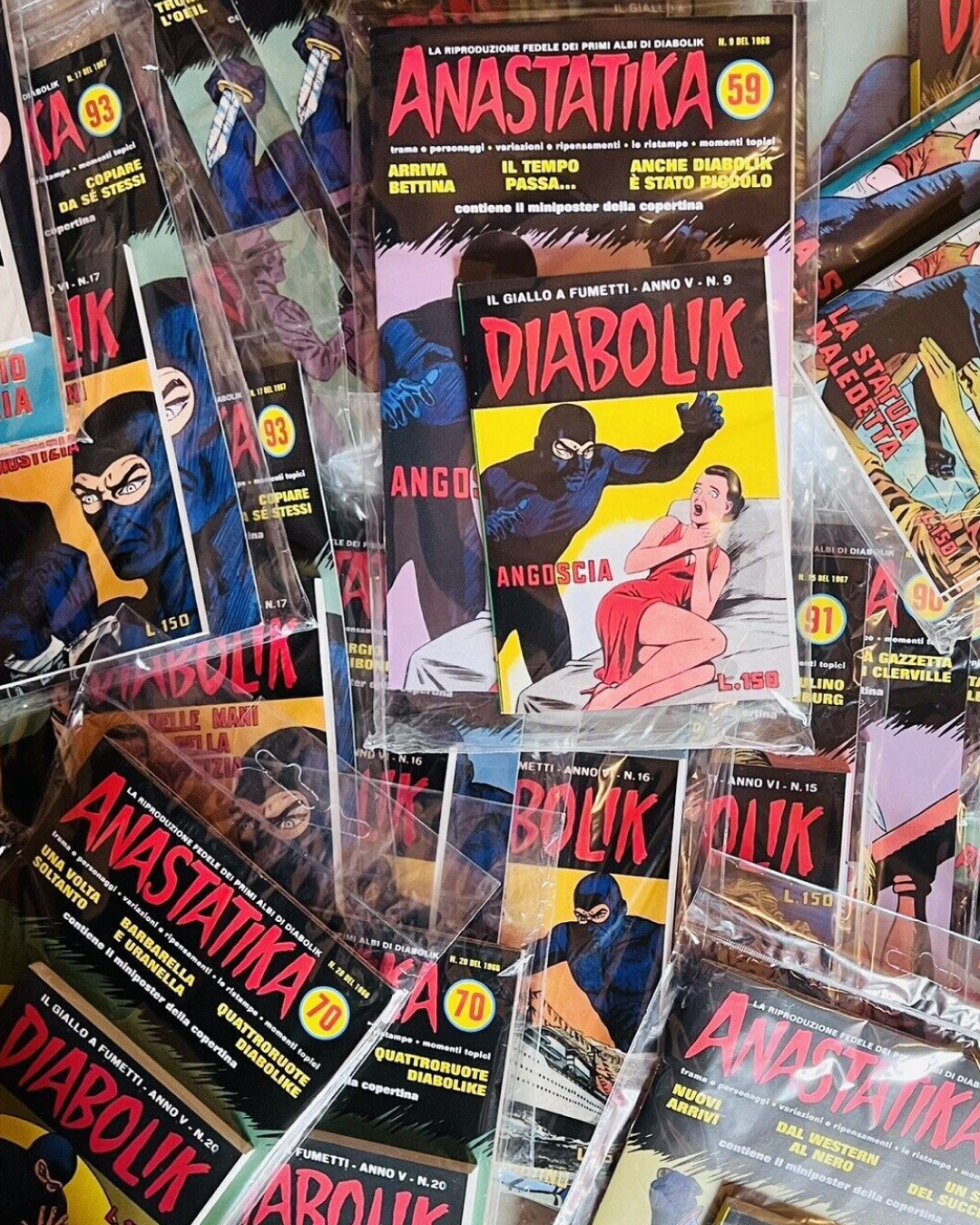
Behind one of the most celebrated criminals in Italian pop culture are two sisters from the Milanese bourgeoisie, Angela and Luciana Giussani. On 1 November 1962, Il re del terrore — the first issue of Diabolik, subtitled Il fumetto del brivido and sold for 150 lire — arrived at newsstands. Not only was the presence of women in publishing far from taken for granted at the time, but comics were still widely regarded as reading material for children. Placing a criminal at the centre of a story filled with theft, murder and sensual atmospheres was hardly a reassuring choice for the respectable classes, and Diabolik faced repeated censorship and scrutiny from the judiciary.
As revolutionary as her creators is Eva Kant, initially a secondary character who became an indispensable presence. Elegant, intelligent and as daring as Diabolik himself, she is certainly not the type to wait at home for her partner's return. Together, the two form a criminal couple in which neither plays second fiddle to the other. Even the format reflects the comic's Milanese origins: small and pocket-sized, it was designed for commuters crossing the city by train every day. A practical solution that became an editorial model, soon imitated by numerous other publications.
How Dylan Dog became the nightmare investigator
In the 1990s, the success of Dylan Dog exploded to reach hundreds of thousands of copies sold per month, at times even surpassing Tex. Proof that a popular comic can also be an auteur work, rich in references and far from reassuring in tone. The universe created by Tiziano Sclavi is a labyrinth of homages to classic horror, to the cinema of George Romero and Dario Argento. Even his London address, 7 Craven Road, is a nod to Wes Craven, director of Nightmare and Scream.
Dylan Dog made his newsstand debut on 26 September 1986 with L'alba dei morti viventi. His name came about through a small stroke of serendipity: Dylan comes from Welsh poet Dylan Thomas, while Dog was reportedly inspired by the title of a Mickey Spillane book, Dog figlio di. Dylan Dog was meant to be a provisional name, to be changed once a definitive one was found. Only no one ever changed it. His appearance, on the other hand, has a precise cinematic origin: Sclavi drew inspiration from actor Rupert Everett. The result is an investigator with a melancholy air and refined features, decidedly removed from the American detective stereotype. On the transport front too, Dylan opts for understatement: no sports cars or high-speed chases, but the now iconic white Volkswagen Beetle.
Zerocalcare tells us how the suburbs went pop
Behind Zerocalcare is Michele Rech, the cartoonist who grew up in Rebibbia and made overthinking, generational anxiety and suburban life his trademark. Since 2011, first on his blog and then in bookshops with La profezia dell'armadillo, he has chronicled small everyday disasters that become a pretext for talking about a generation grappling with its own contradictions: growing up without feeling like an adult, agonising over every decision and always feeling one step behind everyone else.
All set against a backdrop of punk culture, anime, video games and pop references, with an irony that allows you to laugh even at misfortune. In a cultural landscape still in love with extraordinary lives, he chooses to tell the stories of those who don't have all the answers, who get lost in their own thoughts and struggle to find their place in the world. More than heroes to admire, his characters are people you can recognise yourself in.
Lupo Alberto is born between the henhouse and satire
Anyone who grew up in Italy between the 1990s and 2000s cannot help but look back fondly on the iconic Lupo Alberto sweets. The story of the iconic blue wolf actually began on the pages of Corriere dei Ragazzi in 1974. Created by Silver, born Guido Silvestri, and over the years also the product of screenwriters such as Piero Lusso, its extraordinary quality lies precisely in depicting everyday life with great humour: all the inhabitants of the McKenzie farm could have stepped out of any Italian apartment block. His iconic blue colour has a curious backstory: born from a quirk of the printing process, it became one of the most recognisable features of Italian comics.
Corto Maltese was never meant to be the protagonist
When Hugo Pratt first introduces him, Corto Maltese is tied to a raft in the middle of the Pacific. He was not meant to be the protagonist, but one of many characters in Una ballata del mare salato, the first album in the series, published in 1967. Then something fairly rare happened: the secondary character took over the entire story. From there began nearly thirty years of voyages, pirates, revolutions, esotericism, distant cities and real historical figures.
But above all, one of the most recognisable characters in Italian comics was born — so realistic that readers forgot he never actually existed. Many did indeed come to regard him as a real-life sailor, thanks to the almost historiographical precision with which Pratt constructs his biography and the world around him, weaving in historical references, real places, actual figures and fictitious documents, deliberately blurring the line between history and invention.
Valentina: when eroticism becomes art
Born in 1965, Valentina is a Milanese photographer inspired by actress Louise Brooks and her iconic black bob. Moving between dream, eroticism and reality, she became a symbol of a free, complex and unconventional femininity. Valentina ages alongside her creator, who rather than keeping her eternally young — as happens with so many comic book characters — allows her to pass through the different stages of life.
Over the course of the stories, Valentina grows up, has a child and continues to age, reaching maturity without ever losing her allure and sensuality, making her a true unique in the world of comics femininity. With cinematic framing and fragmented pages, Guido Crepax revolutionised the language of comics. More than a heroine, Valentina became a visual icon in which art, pop culture and imagination merge into a style that remains relevant today.