October 15th, 2026
What happens when Scampia changes shape? With the first 97 new homes in the ReStart Scampia project, the neighborhood takes on a new face and rethinks its future
For more than fifty years, the image of Scampia has been tied to a specific shape. Two large inclined bodies, suspended walkways, concrete, and a central void that makes the Vele recognizable at virtually first glance. Now, just a few meters from what remains of Francesco "Franz" Di Salvo's project, completely different buildings are beginning to appear. On October 2nd, the first three completed buildings of ReStart Scampia were unveiled — 97 new apartments expected to be handed over to families between the end of 2026 and the beginning of 2027.
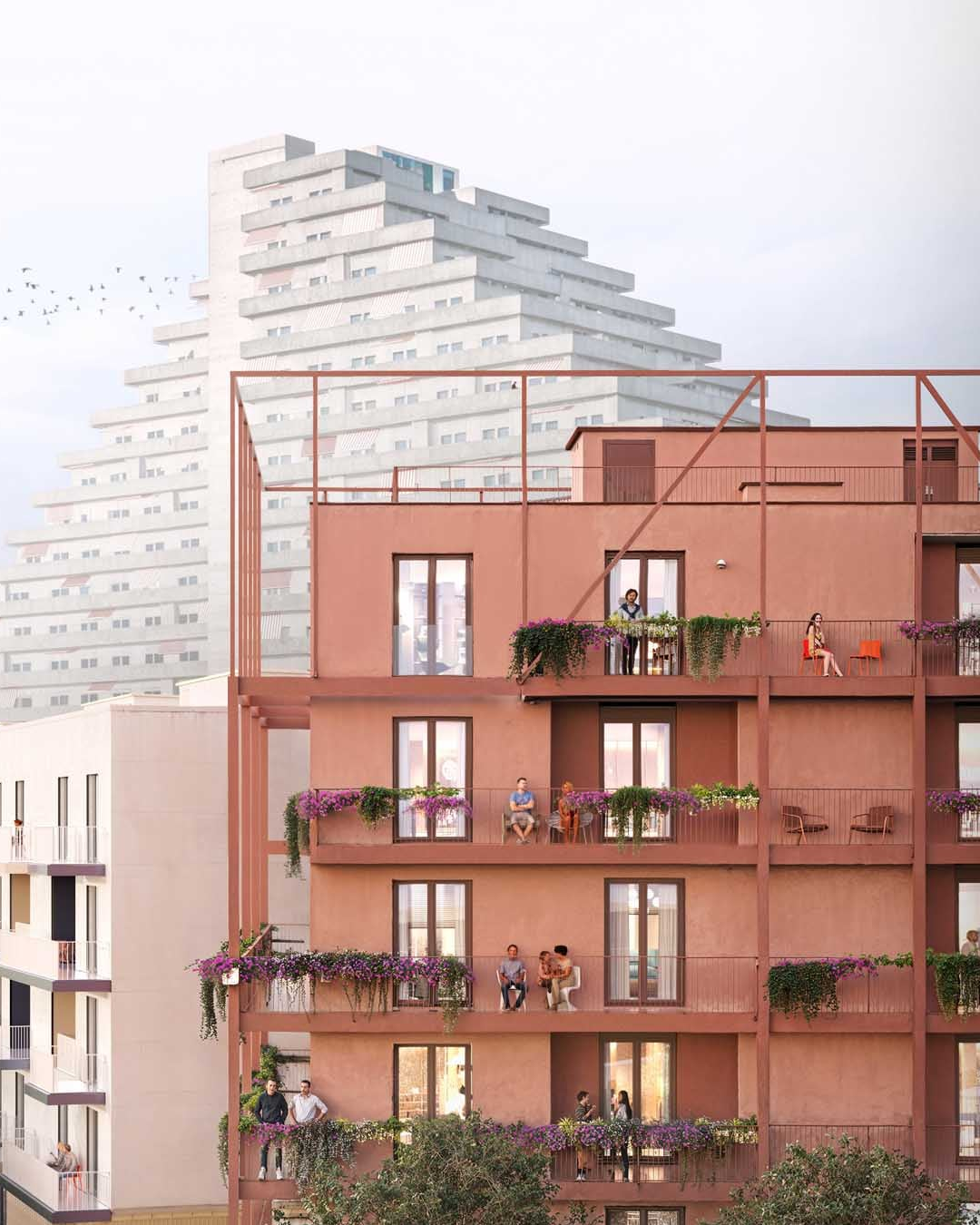
ReStart Scampia: what the 97 new homes built near the Vele look like
One look is enough to understand how much the idea of home has changed. Buildings A1, A2, and A3, designed by Settanta7 together with Studio Perillo and Studio Valle Progettazioni, feature facades in different colors, dual aspect orientation, large windows, and terraces that in some cases measure up to four meters by four. The apartments follow five different layouts, ranging from approximately 50 to 140 square meters, while the ground floors are set to include commercial spaces and community facilities. There are photovoltaic systems and ventilated facades, but the most immediate difference is almost a visual one. Studio Settanta7 itself explains that it worked on differentiation between the buildings, avoiding the repetition of the same facades and balconies over and over.
Looking at these images, it is tempting to frame everything as the replacement of a failed model with a better one. The history of the Vele, however, is far less straightforward. Their form did not originate from a desire to isolate people, but from almost the opposite — an attempt to use architecture to build community. The project included collective spaces and facilities that were never realized as envisioned, while modifications to the original intentions were introduced during construction. Added to this were the lack of infrastructure and services, the housing crisis that erupted after the 1980 earthquake, and social and economic conditions that a building alone could hardly have been expected to control.
From the Vele di Scampia to the new residential buildings: how the neighborhood is changing
@gaetanomanfredi.official A Scampia avevamo preso un impegno: superare definitivamente le Vele e restituire dignità, case e futuro a questo quartiere. Quell’impegno sta diventando realtà. Dove per troppo tempo c’è stato un simbolo di sofferenza, stanno nascendo nuove case. I primi appartamenti sono pronti e saranno consegnati tra la fine dell’anno e l’inizio del 2027. Il programma proseguirà con oltre 500 alloggi, scuole, servizi, verde pubblico e la riqualificazione della Vela Celeste. È uno dei risultati a cui teniamo di più, perché racconta una Napoli che non si limita più ad annunciare: programma, realizza, mantiene gli impegni. Scampia, grazie a questi progetti e con il forte impegno dei suoi abitanti, sta cambiando davvero. E con lei cambia anche l’immagine di Napoli nel mondo. #viral #fyp #scampia audio originale - Gaetano Manfredi
The distance between the old Vele and the new buildings therefore tells a story larger than mere aesthetic change. ReStart Scampia works in virtually the opposite direction. The buildings become smaller and more distinctive, the apartments more varied, and the neighborhood is designed as a combination of homes, green spaces, services, and public areas rather than as a single grand architectural gesture. The overall plan includes new green spaces, community gardens and orchards, a school complex, a civic center, and neighborhood services, while the Vela Celeste will remain standing and be repurposed for non-residential uses. The idea is therefore to leave a physical trace of what Scampia has been without asking that building to continue serving the residential function for which it was originally conceived.
The process that led to this point also matters. ReStart Scampia grew out of a years-long process involving the Municipality, the Vele Committee, and local residents, through public assemblies, open forums, and discussions about the neighborhood's future. Between 2018 and 2021, this process had already led to the demolition of the Vela Verde and the allocation of around 800 public housing units. This is a significant step because it shifts the project — at least in part — away from a logic in which someone imagines from above how a community should live, toward one in which that community plays a direct role in transforming the place it calls home.
The first 97 homes are therefore only the beginning of a much larger transformation. The updated program calls for more than 500 new apartments, as reported by La Repubblica, while in the coming years all the spaces that allow a collection of buildings to truly become a neighborhood will also need to take shape. That is precisely where the hardest part will be played out. Building bright apartments and larger terraces is concrete and measurable; making schools, green spaces, shops, transport, maintenance, and places to gather function over time is far less so.
The future of the Vele di Scampia and urban regeneration in Naples
Perhaps this is also what makes Scampia such a compelling case for Italian architecture today. Within the same stretch of city, two very different ideas about how to design collective living are coexisting. One was born from a modernist faith in the possibility that a radical architectural form could help build a new way of living together. The other attempts to distribute that same complexity across smaller buildings, services, green spaces, public areas, and participation.
There is no need to turn the Vele into a mistake in order to understand why things are being built differently today. If anything, their history says exactly the opposite. A building can be extraordinarily bold, innovative, and even become a symbol of Italian architecture, yet the life that unfolds around it depends on far more than concrete. Scampia is changing shape. The real question will be understanding what happens when those new shapes finally begin to be lived in.