October 20th, 2026
What if skaters could teach us how to design cities? From Milan to Turin and Bologna, skateboarding keeps transforming steps, squares and industrial structures into something designers often never intended
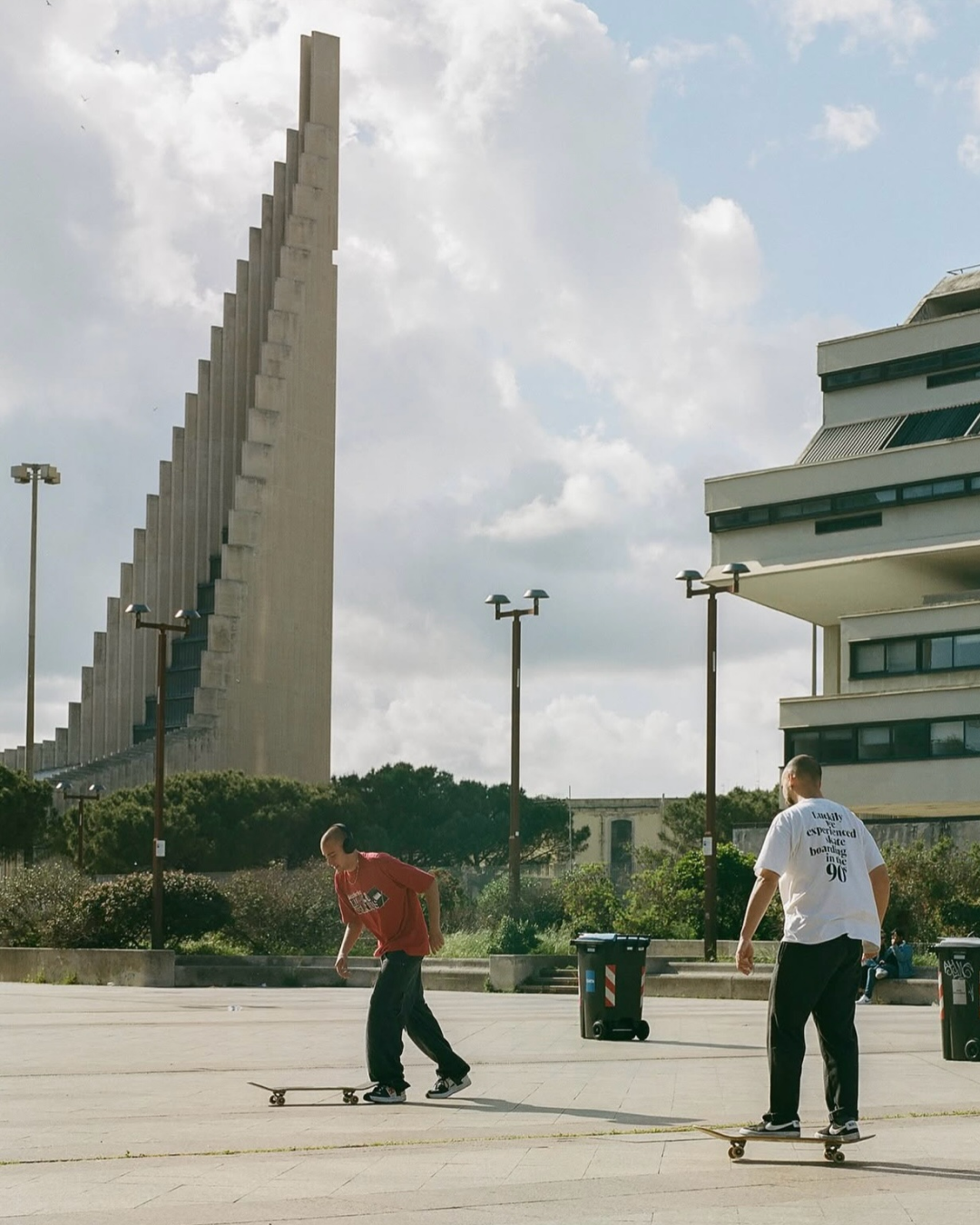
Walking through a city and moving through it on a skateboard are two completely different experiences. A bench may simply be a place to sit, a step is there to overcome a change in level, and a handrail is meant to help you climb a staircase. For a skater, those same things become surfaces, obstacles, curves, heights, and materials to be read. The city remains identical, but the way of looking at it changes completely.
It is precisely this ability to see possibilities where the design had intended a specific function that makes skateboarding interesting from an architectural standpoint as well. Iain Borden, Professor of Architecture and Urban Culture at the Bartlett in London and author of one of the leading studies on the relationship between skateboarding and the city, has spent over thirty years studying how skaters reinterpret urban spaces. His point is fairly straightforward. A city is not produced solely by those who design it, but continues to be transformed by what people decide to do within it.
Skateboarding makes this particularly evident because it works directly with existing architecture. In the literature on the subject, these are defined as "found spaces" — spaces and objects that were not designed to be skated but become usable through practice. Staircases, low walls, ramps, curbs, and plazas change meaning without anything being materially altered. A study published in Frontiers draws a clear distinction between "found spaces," purpose-built skateparks, and spaces constructed by skaters themselves. Street skateboarding lives primarily in the first category — that is, within the ordinary city.
Skateboarding in Milan: how skaters reinterpret urban architecture
Milan offers plenty of examples. Domus reported as early as 2020 how skaters had transformed spots such as the plaza in front of the Bocconi University designed by Grafton Architects, and the spaces around Milano Centrale station. What is interesting is that spectacular architecture is not necessarily required. What matters far more is the quality of a surface, the height of an edge, the continuity of a pavement, or the material of a bench. Elements that are almost incidental to someone simply passing through a space can become the main reason a skater decides to return.
Naturally, this alternative reading of the city also generates conflict. At Milano Centrale, for instance, skate stoppers — small metal devices fitted to ledges specifically to prevent boards from sliding along them — appeared years ago. Corriere della Sera reported in 2013 on the tension between the spontaneous spots used by Milan's skaters and certain skateparks built without involving them in the design process. This dynamic remains central to this day. If skateboarding is born from the free use of the city, building a dedicated space can mean recognising it — but it can also simply become a way of moving it somewhere else.
From Milan's skateparks to Via Pontano: skateboarding becomes part of public space
In Quarto Oggiaro, something different happened. In 2018, the initial skatepark project called for standard modular structures in metal and wood, but the Milano Skateboarding association gave a negative assessment and was directly involved in developing an alternative solution. From that dialogue emerged a 556-square-metre space designed in collaboration with UAO Skateparks, conceived not as an object separate from the park but as an "skateable extension of public space." Ramps, ledges, and surfaces were integrated into the design of the place rather than simply dropped inside an enclosure.
In recent years, this same logic has appeared in other Milan projects. At the end of 2024, the redevelopment of the railway underpasses on Via Pontano incorporated skateboarding directly into a broader public space project. The four tunnels between Viale Monza and Via Padova became the Tunnel Boulevard, bringing together urban art, new pedestrian areas, and a distributed skatepark. In the Via Merano tunnel, a large covered half-pipe was also built. Here, skateboarding does not arrive after the project is complete — it becomes one of the tools used to animate a place that had previously been little more than a thoroughfare.
Parco Dora in Turin: when skateboarding transforms industrial architecture
In Turin, the relationship is different again. Parco Dora was born from the transformation of a vast industrial area and still retains the sheds, pillars, and structures of the former steelworks. Beneath the great Stripping Shed of the Vitali area, activities such as basketball, parkour, graffiti, and skateboarding have gradually converged, to the point that the City now describes that section of the park as a genuine urban sports hub. The industrial architecture was clearly never designed with a skateboard in mind, but its roof cover, vast surfaces, and absence of any rigid function made the space particularly easy to reinterpret.
Here too, when the time came to replace the deteriorating old structures, the design process ran through those who actually used the space. In 2020, Skateboarding Torino submitted a feasibility study to the City that became the basis for the new facilities at Parco Dora. This is a telling detail, because it reverses the classic relationship between designer and user. Skaters do not simply arrive at the end to use a space that has already been decided for them — they possess a form of technical knowledge of the city that can feed directly into the design process.
That knowledge extends to extremely simple things. A surface that is too rough can make it impossible to ride a board, a few centimetres can completely change an obstacle, and a crack that is nearly invisible to a pedestrian can break a line entirely. In 2025, the situation at Parco Dora had reached the point where a City Council question noted children filling cracks in the skatepark with improvised materials to make it usable again. A rather extreme scene that illustrates how building these spaces without maintaining them means rapidly losing what makes them work.
Skateparks in Bologna and Naples: new frontiers in urban regeneration
Bologna shows how this culture can be woven into spaces that serve many different purposes simultaneously. Piazza Lucio Dalla, inaugurated in 2022 beneath the former roof structure of the Bolognina wholesale fruit and vegetable market, covers nearly six thousand square metres and combines concerts, neighbourhood activities, food and drink, and skateboarding. The City describes it as a plaza designed to shift continuously between different activities throughout the day, while the European Commission has included it among European case studies in public space transformation. The sharp division between "a place for skaters" and "a place for everyone else" no longer holds.
Bologna is continuing in this direction. Just a few days ago, the project was unveiled to transform part of the old skating rink at Lunetta Gamberini into a new skateboarding area, set alongside table tennis, free play, new seating, and greenery. In Naples, meanwhile, 2026 saw the launch of a project to create at the Kobe Park in Arenella what is described as the city's first public skateboarding area, carved out of a sports space already used for basketball and built largely through grassroots initiatives and local associations.
The future of skateboarding in Italian cities: beyond traditional skateparks
Taken together, these experiences point to an interesting shift. For a long time, the relationship between skateboarding and architecture was almost a game of catch-up. Designers created a space, skaters discovered an unexpected way to use it, and in some cases bans or small deterrent devices followed to stop them from doing so. Today, some Italian cities are beginning to involve that same culture in the design process itself, moving from the skatepark as an enclosure to the idea of public space that can be skateable alongside many other things.
A contradiction remains, however. Street skateboarding works precisely because it does not wait for architecture's permission. A study published in the British Journal of Criminology describes street skating as a practice capable of challenging the aesthetic and functional order of public space. A staircase designed to be climbed becomes something to descend, a bench stops being a seat for a few seconds, and a plaza intended to be crossed becomes a place where people stay for hours.
Perhaps this is precisely what skaters can teach those who design cities most effectively. A good public space does not necessarily need to anticipate everything that will happen within it. It can also leave enough freedom for someone to find a use that never existed on the plan. Skaters have been doing this for decades. They look at a finished piece of city and start designing it all over again.