July 10th, 2026
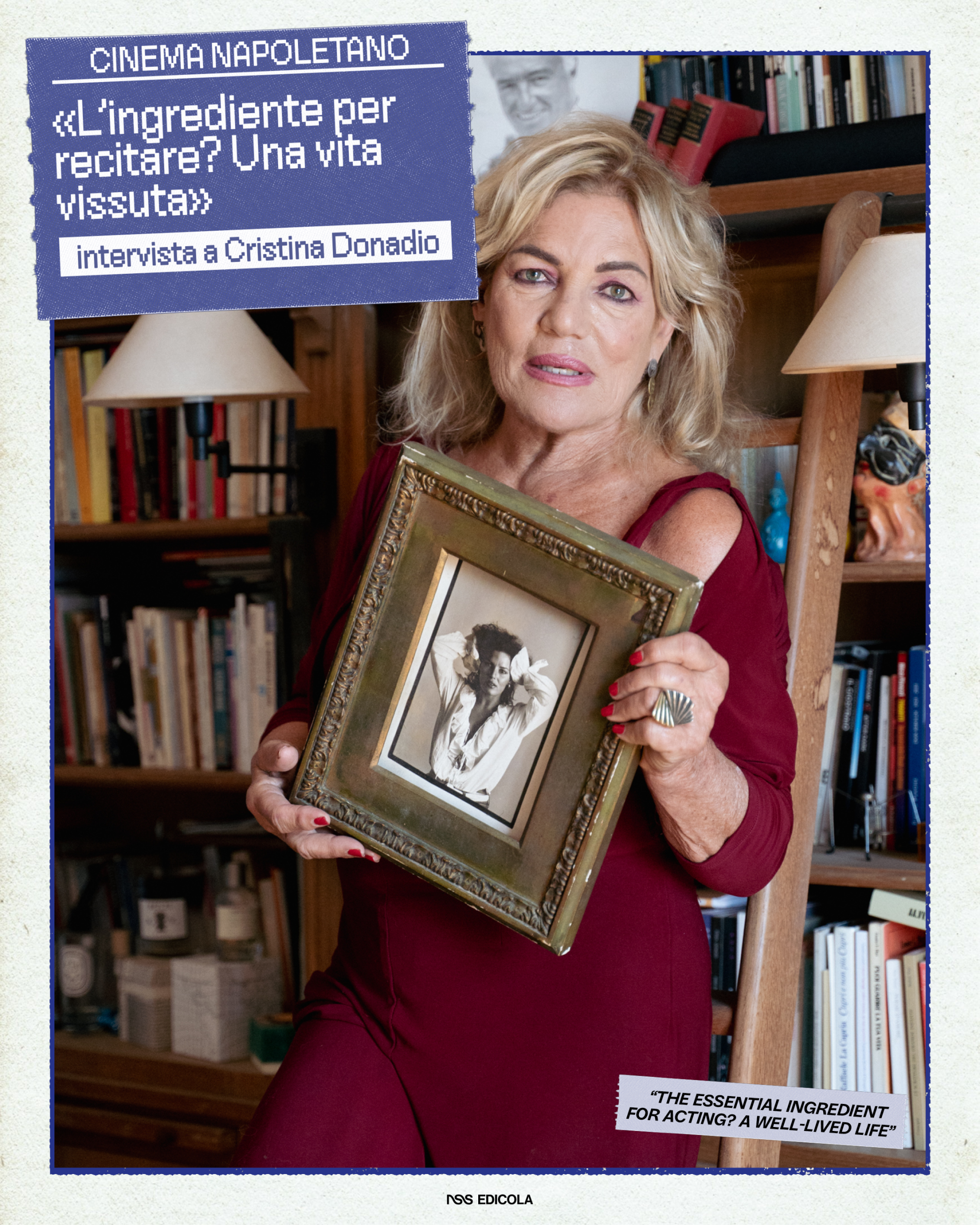
«The essential ingredient for acting? A life fully lived», an interview with Cristina Donadio Excerpt from Cinema Napoletano, the second free press by nss edicola
This interview is part of Cinema Napoletano, the second issue of nss edicola's free publication, produced in collaboration with MUBI for the first Naples edition of MUBI Fest. The editorial project explores the history of Neapolitan cinema through the voices of directors, actors, producers, exhibitors and key figures who continue to shape its identity, examining the deep connection between Naples and the silver screen.
As we sit down for our conversation, Cristina Donadio is currently in cinemas with Le bambine by Valentina and Nicole Bertani. Born in 1960 and originally from Posillipo, Naples, the actress is delighted to have been part of what she describes as «a special film made by special people», calling it «a journey through the five senses where the directors' story becomes universal and visionary». She could not be more right. Premiering at the Locarno Film Festival before its theatrical release, the film is the latest title in a long career spanning both film and television, one she is proud of, just as she is proud of her life, her profession and the awareness she has gained throughout an entire career, all of which she reflects on in this interview.
Did you decide to become an actress from a young age? Was it a calling?
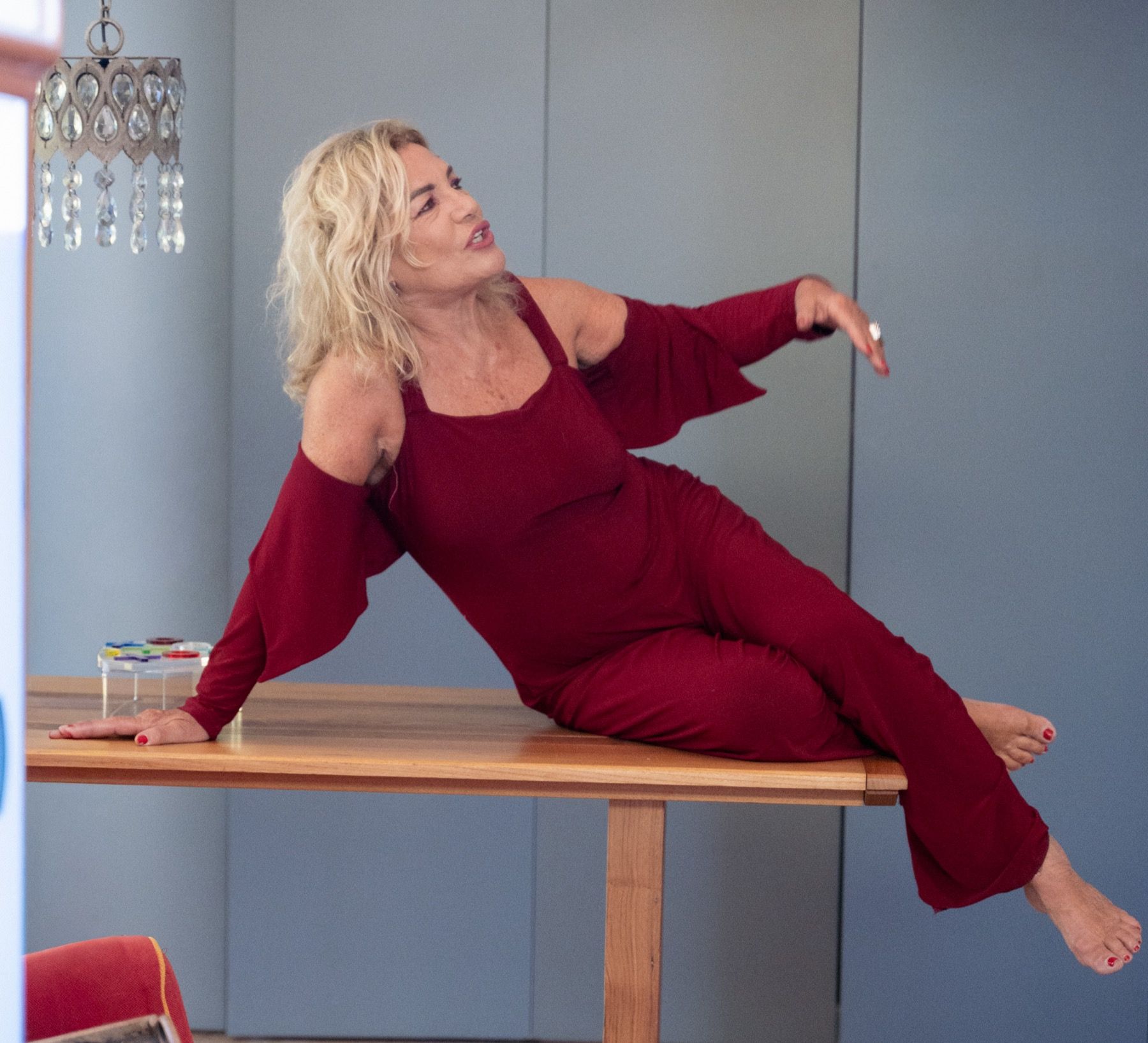
My mother used to say: you're such a clown. What she meant was that I loved to play. I played and I performed. In primary school I memorised a very long poem, Breus, the Knight of Knights, and even my teacher was amazed by how I could recite it by heart. At home, my grandfather would have my siblings and me climb onto the table, give us five hundred lire in silver coins and say: now each of you do something. The money wasn't what mattered, it was what that exchange represented. And once I got up there, I never wanted to come down. My grandparents' kitchen table was my first stage. I don't know whether a calling can be summed up by the expression my mother used about "being a clown", but I do know that, even then, I was already aware that this was how I loved to express myself.
How did you make the transition from theatre, where you began, to acting in front of a camera?
It happened during my first theatre tour. At the time Werner Schroeter was in Naples scouting locations and looking for inspiration for what would become Nel regno di Napoli. When I told my family I wanted to give cinema a try, my father replied: «That's fine, but I'll only consider you an actress after you've won an Oscar.» Of course, the Oscar was symbolic. What he meant was that if I chose to follow that path, I had to take it seriously and never settle for less. My father, who loved art, cinema and classical music, and who adored Charlie Chaplin—whose work shaped my imagination from an early age—gave me one of the most important lessons of my life in that moment.
And how did your debut go?
Schroeter was one of the leading figures of the German New Wave, alongside Rainer Werner Fassbinder, Wim Wenders and Werner Herzog. He was a true nonconformist, living in Mexico despite being German, and with Nel regno di Napoli he told the story of two brothers from their birth in the early 1940s to their deaths in the 1970s. It was a wonderful film that received considerable acclaim abroad but far less here in Italy. In Naples, it wasn't understood. When it was released in 1978, the city was going through a difficult time, and Schroeter's rational, detached perspective unsettled the people who lived there, preventing them from seeing the affection and fascination hidden beneath the surface. As for me, it remains a wonderful adventure. And anyone who wishes can still discover it on MUBI.
What other experiences have left a lasting mark on you?
The biggest mistake I ever made was leaving the set of La città delle donne by Federico Fellini. I still regret it to this day.
What happened?
My agency arranged an audition with Fellini. I went to the legendary Studio 5 at Cinecittà, introduced myself, and he asked me to tell him about myself. As we talked, he kept sketching on a piece of paper. When he finished, he handed it to me and said: this is your character. I was going to play Marcello Mastroianni's recurring dream. I signed the contract, but after spending a month going to the set every day fully made up, in costume and getting paid without filming a single scene, I decided to leave. I went back to my agency and told them I wanted to quit in order to make another film, Bim bum bam by Aurelio Chiesa. It was a foolish, arrogant and childish decision. Fellini didn't work with a production schedule. He would arrive on set and decide what to shoot on the day. At the time I couldn't understand that I could have learned so much simply by staying there and observing. But thanks to that mistake I learned not to make the same one again. Or at least, I've tried.
There was another legendary figure you turned down the chance to work with: Eduardo De Filippo.
That time, though, I have no regrets. It was during the period when he was adapting his plays for television. He asked me to play his daughter in Il sindaco del Rione Sanità. At the time I was touring with Nino Taranto, a great actor and playwright who had a long standing rivalry with De Filippo because he was often seen as the more popular entertainer. Even though he wasn't happy about it, he told me to go. When I arrived at Cinecittà to sign the contract, where filming was taking place, Eduardo De Filippo called me over and said: I've changed your role. I was no longer playing the daughter but a virtually insignificant character who only appeared in the third act. So I left. Everyone told me I was crazy, but to me it was simply unfair. I had left a theatre tour for that role, and it had been taken away from me. Of course, De Filippo never called me again, but if I could go back, I would make exactly the same decision.
In 1993 you worked with Pappi Corsicato on Libera, a film that marked an important turning point in your career. What do you remember about that collaboration?
Between Nel regno di Napoli and Libera, I worked on several smaller film projects, with varying degrees of success. Pappi had just returned from New York, bringing back with him countless images and ideas he had absorbed abroad and wanted to bring to life. Since he had been away for so long, I helped him reconnect with the local creative scene, and over time he managed to make Libera, a landmark film of 1990s Italian cinema. I would pair it with Le bambine because of its bold, creative spirit, one that remains completely intact to this day. In fact, I think its value is recognised even more now than it was when it first came out. It was originally released as a niche arthouse film, but over the years it has found a much wider audience, as demonstrated by the recent restored version we presented, which drew a remarkable number of viewers.
How have your Neapolitan roots influenced your work as an actress?
For a long time I had a complicated relationship with my Neapolitan identity, mainly because, at first, I hardly thought about it. It was other people who kept pointing it out, though not in the way you might expect. I was always considered a rather unconventional Neapolitan because I didn't have a strong accent, I came from a middle class family, and I didn't fit the stereotypical image that cinema often had of actors and actresses from Naples. For certain roles I wasn't even considered because people didn't believe I could speak my city's language. The truth is that acting has always meant something else to me. It means becoming someone else, losing myself in a character, and Scianel in Gomorra proved that I could fully embrace Neapolitan dialect as well.
In what way?
My career can be divided into before and after Scianel. When I played her, I refused to rely on clichés. To me she wasn't simply a Camorra boss, she was closer to Lady Macbeth or Clytemnestra. Acting is something profoundly personal. As different as our lives may have been, I still had to dig into my own demons to bring the character to life. It's a lesson I learned from Enzo Moscato, whom I met during a period of loss that brought us very close. He told me that acting is not a comforting profession. It's not narcissism. You have to turn the camera on yourself and draw from your own emotions to make a character live. Not simply portray them, but truly inhabit them. Lived experience is the essential ingredient, the only real card you have to play in a profession where there is no room for pretending.
Which places in Naples feel the most cinematic to you? Is there still a hidden gem waiting to be discovered?
Naples has been portrayed in every possible way and from every conceivable angle. I live in a beautiful part of the city, Posillipo, overlooking the sea. It's a place celebrated by poets and writers alike. It's where I feel most at home, and filmmakers such as Mario Martone, Paolo Sorrentino and Pappi Corsicato have captured its grandeur magnificently on screen. But Naples is also a city marked by deep structural scars. It has been destroyed and battered over time. Entire layers of its history have been buried beneath concrete. Yet it is so full of life that I believe it can continue to be told through stories forever, not only through the familiar stereotypes of mandolins and Neapolitan songs, but by exploring its most authentic soul. The important thing is never to become accustomed to its beauty. From my home I can see the outline of Naples, Capri and Mount Vesuvius. It's a landscape that is constantly changing, one that moves me every single day.
We've looked back at the beginning of your career and some of its defining moments. But what is your very first, most vivid memory of cinema?
For a period of my life, cinema was synonymous with summer. Every summer, television would broadcast a selection of auteur films, from Hitchcock to Rossellini and Fellini. The very best of Italian cinema, from the great masters of drama to the icons of the commedia all'italiana. Beautiful films, black and white classics, starring legendary actresses such as Ava Gardner and Veronica Lake. They were untouchable figures, almost mythical, and watching them filled your heart. My father used to watch those films with us before we'd head down to the beach. As for going to the cinema, I vividly remember when my sister and I went to see Tutti per uno by Richard Lester. We were huge Beatles fans and had persuaded our parents to let us go on our own. I had a crush on George Harrison, while she adored Paul McCartney. What I remember most is the sense of freedom we felt, especially being able to scream our love for the Beatles while feeling part of a community.
Even though MUBI began as a streaming platform, through its festival it also encourages people to come together. Looking back on your career, what is one particularly meaningful moment of connection that stands out?
During the Gomorra years, we used to gather at Stefano Bises's house to watch the first and last episodes of each season together. I always went while I was part of the cast, and I even returned after my character was no longer in the series. Roberto Saviano would join us as well, and those evenings became a testament to how much we had truly become a family. That was the most beautiful thing about making Gomorra: the genuine relationships we built with one another.