November 1st, 2026
The new era of the artisan cookie From hyper-sugary guilty pleasure to a subject of culinary research, spanning high-end pastry, de-junking, and aesthetics
If in recent years our feed has been dominated by cubic croissants, high-engineering viennoiserie and specialty coffee extracted with surgical precision, we should brace ourselves for a changing of the guard. The new cult object of urban pastry takes the sweet symbol of America and reinterprets it through the codes of accessible luxury: the cookie.
For decades confined to the junk food imagery of shopping malls or the industrial dunking pack, the oversized biscuit from across the Atlantic is undergoing its own personal transition toward a premium positioning. Driven on one side by the social media obsession with the chewy effect and on the other by the demand for a new artisan pastry scene, the cookie has moved beyond the boundaries of a passing trend to become the new status symbol of breakfasts and urban breaks. But what happens when artisan pastry decides to reinvent one of the world's most pop icons? We asked three protagonists of the new Italian wave.
DOHM in Milan: artisan cookies
Serving as the perfect contemporary hook for this new era is Dohm, the new space inaugurated on October 10, 2026, in the heart of Milan, at Via Sforza 3. The name itself is a refined play on words, weaving together the English word dough with the letter M, symbol of the city where it all begins. The two founders, Marc-Antoine and Marco, chose to apply the rigor of fine hospitality to an icon of American bakery, undertaking a full two years of study before opening and enlisting the collaboration of an Italian chef for recipe development.
The real breakthrough lies in the de-junking process: "We went to New York to taste the most famous cookies: delicious and generous, but often very sweet," the founders explain, "our challenge was to create the perfect biscuit, crisp on the outside and melting at the core, eliminating additives and working on the perfect sugar balance to let the pure quality of the ingredients shine through." No preservatives or synthetic colorings enter the laboratory, and a careful study of texture has been successfully extended to the extra-dark chocolate vegan version as well, formulated to deliver a rich, structured palate experience entirely comparable to the classic one.
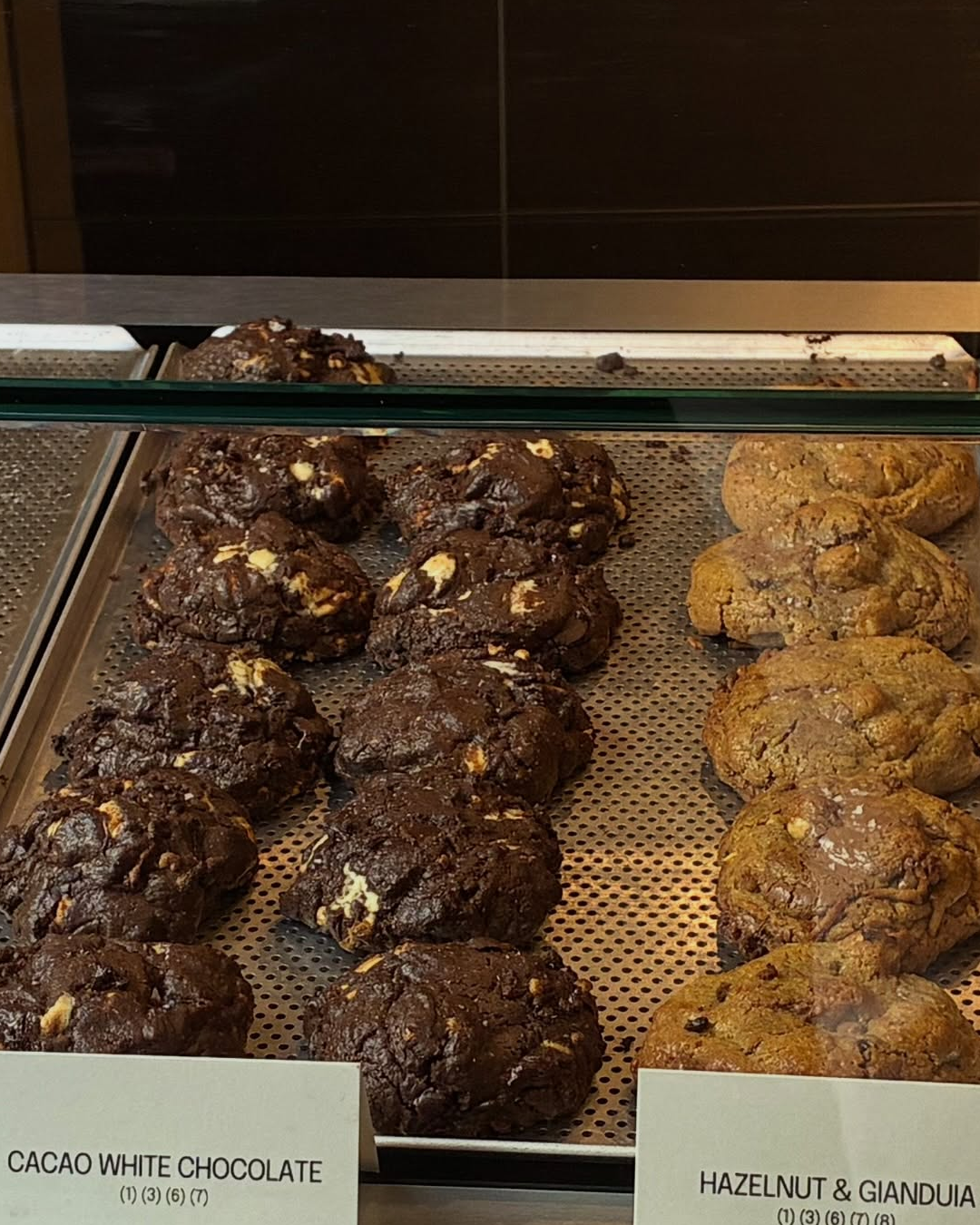
The cookies are available until sold out from a menu of seven seasonal varieties, featuring carefully researched combinations such as the dark chocolate and in-house caramelized banana version, or the reinvention of peanut butter made with salted peanuts and caramel chocolate. As the owners emphasize: "The cookie is no longer a snack, but an all-day-long ritual that speaks to an international clientele attuned to aesthetics and the overall design of the experience."
The domestic micro-laboratory: Ella Pastry Lab in Turin
Before the phenomenon exploded across Italian feeds, someone in Turin was already working quietly outside the traditional rules. Ella, with a background in classical catering between Brazil and the Piedmontese capital, found in the cookie the perfect compromise between life, autonomous management (through the Home Food Business model) and artisan creativity. "I used to work with chocolate, then motherhood arrived and I could no longer fit into the shift logistics of a pastry shop. I was looking for my own path and I saw in the cookie a possibility: a manageable product that would let me express myself while maintaining obsessive control over quality," Ella recounts.
With an artisan output of around 500 pieces per month handled entirely on her own, Ella offers a tight selection of 5 fixed flavors plus one monthly creation: "Modern pastry has often elected the croissant as the symbol of experimentation, but for me the cookie is a continuous exercise in balance. In Brazil or the United States, filled cookies are extremely common, but they often end up cloying. I had to readjust the balances: less sugar, high-quality butter, and the inclusion of local ingredients like Piedmontese hazelnuts to create familiarity on the Italian palate."
The profile of Ella's customers? A broad audience, but strongly driven by Gen Z and expats: "I have customers of all ages, from university students at the Politecnico to buyers from southern Italy. The younger ones are drawn in by the story and the aesthetics, but it's the substance of the bite that brings them back."
The elevation of the format: Chewie Cookies in Rome
In the Roman pastry landscape, Chewie Cookies represents the vanguard of this movement. Born before the global fever for Crumbl cookies swept across TikTok feeds, Barbara and Andrea treated the biscuit as a base for recreating cakes and individual restaurant-style portions on a different medium. "Abroad, the cookie is often seen as junk food. We applied the techniques of great Italian and French pastry to transform it into a complex dessert, where crunchiness, creaminess, salty notes and acidic components coexist as in a small cake," the two founders explain.
With over 130,000 cookies sold in the first year and a catalog of more than 60 recipes — ranging from the classic Chocolate Chips to Lemon Pie with flambéed curd, to the biscuit inspired by Bread, Butter and Jam, and the Panettone cookie — Chewie has dismantled the idea of the pre-packaged biscuit. As Barbara and Andrea declare: "Everyone thought of the traditional cookie, with the classic chocolate chip. We were among the first to introduce high-end chocolate chunks, which don't melt completely but retain their texture. There was some initial reluctance about the price or the format, but once people understand the made-to-order preparation process behind it, the perception changes completely."
In the open-view laboratory in Monteverde, the biscuits are baked and decorated on the spot with freshly made in-house creams, avoiding oxidation at the counter or the logic of industrial production with rapid blast-chilling. A rigor that has led them to discourage hasty on-the-go consumption, instead offering takeaway boxes of 3 or 6 pieces designed for mindful sharing.
Beyond the trend: a flash in the pan or a new pastry category?
got milk and cookies at the restaurant https://t.co/E16pu3rx1U
— John 2 (@John2Zone) June 29, 2025
As has already happened with the smash burger or the new viennoiserie, every cultural phenomenon carries with it the risk that the novelty effect generates superficial imitations. But when attention shifts to the real quality of ingredients and the architecture of flavors, a passing trend can create space for new pastry categories.
The convergence between the bespoke research of micro-laboratories, entrepreneurial vision, and the gastronomic engineering of contemporary interpreters demonstrates that the cookie has now earned its own artisan standing. A perfect meeting point between visual culture and the substance of the bite: transparent in its ingredients, democratic in price, and refined in flavor.