June 30th, 2026
How are Milan’s swimming pools doing? An update on the city's most discussed destinations
In Milan, the closest places to cool off and go for a swim without traveling all the way to the lakes or the sea are the Idroscalo and the city's public swimming pools. However, as also reported by La Stampa, «there are only three outdoor municipal pools available to residents: Romano (Città Studi district), Cardellino (Baggio), and Sant'Abbondio (South Milan). This is a significant issue in a metropolis of more than 1.3 million inhabitants, where many historic facilities remain closed for renovation work or are still awaiting redevelopment.»
In recent days, one piece of news has lifted the spirits of Milanese residents struggling with the heat: the Argelati swimming center, built in 1915 and closed in 2022, will reopen thanks to a €28 million public investment. Citizens, public bodies, and local associations will contribute to designing the center's new spaces, which, according to the report released this June, will include a roof to make it usable all year round. The collaborators also expressed the intention of turning the pool into a third place capable of hosting events, evening openings, and educational activities. The project will now be handed over to an architecture firm selected through an international competition.
But the Argelati pools are not the only swimming facility in Milan with a complicated history.
Bagni Misteriosi
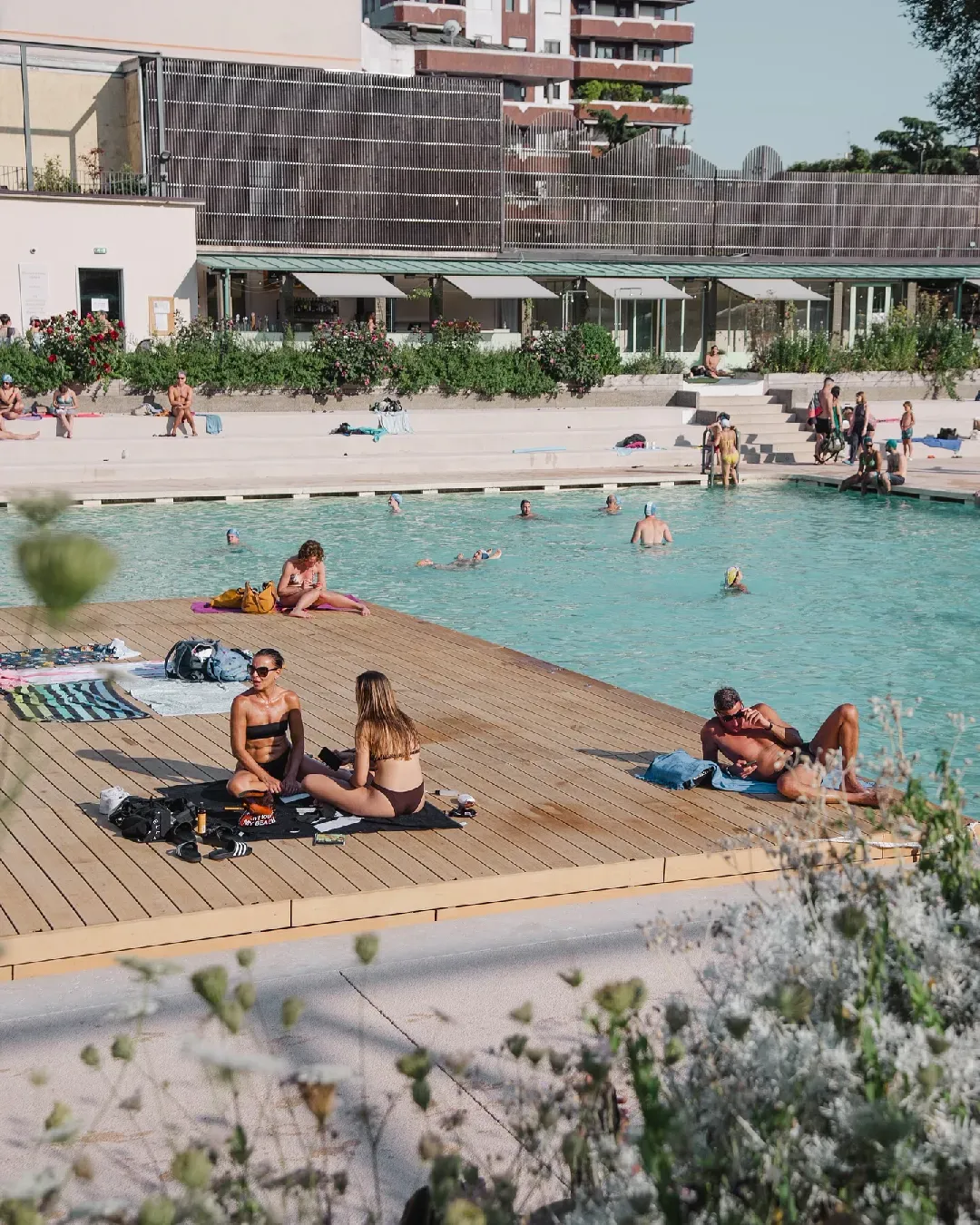
Among the city's private facilities, the best-known and most popular is Bagni Misteriosi, which reopened in recent years after a long period of abandonment and has once again become one of the most appreciated summer destinations in the city. During the first twenty-five days of the season, the facility recorded 26,000 admissions, around 13% more than last year.
Many of Milan's swimming pools were built between the 1920s and the 1930s, and several of these facilities are still in operation today, often serving different purposes. Bagni Misteriosi itself, built in 1929 and originally known as Caimi Pool, now hosts concerts and film screenings, among other events, while in winter it becomes an ice skating rink. Likewise, Cozzi Pool, not far from Porta Venezia, is not only home to the Italian Swimming Federation but is also frequently chosen as a venue for events—for example, in 2019 it was one of the locations for Milan Fashion Week.
Milan's most important swimming pools
Many of Milan's historic swimming pools share similar architectural features because they were designed by the same architect, the Tuscan Luigi Lorenzo Secchi. His best-known works include Romano Pool, inaugurated in 1929 in the Città Studi district and named after gymnast Guido Romano; at the time, it was the largest outdoor swimming pool in Europe. Other projects include Caimi Pool (today's Bagni Misteriosi) and Cozzi Pool.
After the Second World War, alongside the reconstruction of Milan (Secchi also oversaw the restoration of Teatro alla Scala), many new swimming pools were built. It was during this period that these facilities ceased to be places frequented only by the elite and became accessible to an increasingly broad segment of the population.
What about the Idroscalo?
Today, the Idroscalo is one of Milan's main sports and recreational facilities. Located on the eastern outskirts of the city, it covers a total area of 1.6 square kilometers and features an artificial lake of approximately 800,000 square meters surrounded by a park. Around twenty different sports can be practiced here, from rowing to water skiing. It also hosts summer camps for children and teenagers, dog-friendly areas, and a beach stretching along the entire eastern shoreline. Unsurprisingly, it is also known as the «Sea of Milan.»
Its origins, however, are very different from the way it is used today. Construction began in 1928, and numerous archaeological finds were uncovered during excavation. The Idroscalo was inaugurated in October 1930 as a base for seaplanes, because in the second half of the 1920s this type of aircraft was believed to represent the future of aviation. For this reason, Milan decided to build a basin specifically designed for seaplanes.
Things turned out differently, however. With the rapid development of conventional airports, seaplanes quickly lost their importance. The Idroscalo was therefore converted into a venue for water sports and, starting in the 1990s, became one of Milan's favorite summer leisure destinations.