
August 19th, 2026
Italy's most romantic secret gardens open in the summer Among villas, botanical gardens, and places where summer slows down
In summer, Italy is often told through beaches, villages, terraces and art cities full of light. Gardens, however, offer another idea of travel. Slower, more shaded, quieter. They are places where the landscape is designed with the same precision as a building: avenues, fountains, greenhouses, ruins, terraces, woods, viewpoints and blooms construct a different way of moving through the season.
“Secrets” does not necessarily mean unknown. Some of these places are extremely famous, others require a more carefully planned visit. All of them, however, allow you to see summer from a less obvious perspective. Not as a quick consumption of the landscape, but as time to inhabit slowly. They have one thing in common: they remind us that summer can also be shade, time, silence, walking, waiting. In a moment when every place risks becoming content to be consumed in a hurry, gardens still ask for a different gesture. Enter, slow down, look longer. And perhaps it is precisely there, between a fountain, a ruin, an avenue and a terrace, that the Italian landscape once again feels truly alive.
1. Botanical Gardens of Villa Taranto, Verbania
On Lake Maggiore, the Botanical Gardens of Villa Taranto are one of the most scenic places to understand what a garden can become when botany meets an almost theatrical vision. Avenues, basins, terraces, geometric flowerbeds and thousands of plant species create an orderly yet surprising path, where every season changes the way the garden reveals itself.
In summer, Villa Taranto works because it combines coolness, water, colour and a sense of discovery. The lake remains in the background, while the garden becomes a sequence of different environments: more formal in some points, more immersive in others. It is a perfect visit for those seeking an accessible yet highly constructed beauty, where nature appears spontaneous only after having been organised with extreme precision.
2. Boboli Gardens, Florence
Boboli is the most famous name on the list, and therefore also the one to look at with greater attention. Behind Palazzo Pitti, the Medici garden is not merely a classic stop in Florence, but a true landscape machine made of perspective axes, sculptures, grottoes, terraces, fountains and ascending paths. It is one of the places where the Italian garden becomes almost a form of urban power.
In summer, Boboli should be experienced by stepping away from the most automatic visit. Its charm grows when you get lost in the side paths, in the shaded spots, in the less crowded areas, in the inner gardens and in the sudden openings onto the city. It is a monumental garden, of course, but also a place where Florence slows down and changes scale. From the tourist-filled street you enter a vegetal city, built for walking, climbing, looking from above.
3. Bardini Garden, Florence
Not far from Boboli, the Bardini Garden has a more intimate and vertical character. It is one of those places that seem to belong to Florence and at the same time to remain slightly outside it. Its strength lies in the relationship between slope, view, vegetation and architecture. You climb, you cross terraces, stairs, pergolas, green corners, and the city appears at intervals like a stage set.
The wisteria is its best-known image, but in summer Bardini remains interesting even beyond the flowering. It works as a panoramic garden, as a pause from the historic centre, as a space in which the urban landscape becomes almost domestic. It is less solemn than Boboli, more enclosed, better suited to a slow visit. One of those places where Florence feels less like a museum and more like an outdoor room.
4. Garden of Ninfa, Cisterna di Latina
The Garden of Ninfa is probably the most narrative on the list. Here nature grows inside the ruins of an abandoned medieval town, among walls, towers, bridges, watercourses and plants that seem to have reclaimed history. It is a garden that works not only on botanical beauty, but on a rarer sensation: that of entering a suspended place, where time has not been erased and continues to live in the form of vegetation.
Visits are regulated by calendars and controlled access, so it must be planned carefully. Precisely this dimension makes it even more special. Ninfa is not consumed like an ordinary stroll. It is crossed with a guided rhythm, in a delicate balance between protection and wonder. In summer it is one of the most powerful places to see because it transforms heat, water and shade into an almost unreal experience.
5. La Mortella Gardens, Ischia
In Forio, on the island of Ischia, La Mortella is a Mediterranean and subtropical garden created from 1956 by Susana Walton, wife of the English composer William Walton. Its identity is born precisely from the encounter between landscape, botany and musical culture. It is not only a garden to visit, but a place where plants, paths, concerts and private memory construct a very precise form of beauty.
La Mortella is perfect for summer because it belongs to the sea without turning into a simple coastal garden. It has a collected, almost secret dimension, made of shade, changes in level, rare species, views and places to stop. It is a garden that shows another Ischia, far from the island’s most immediate image. Less beach, more vegetation. Less postcard, more atmosphere.
6. Monumental Garden of Valsanzibio, Galzignano Terme
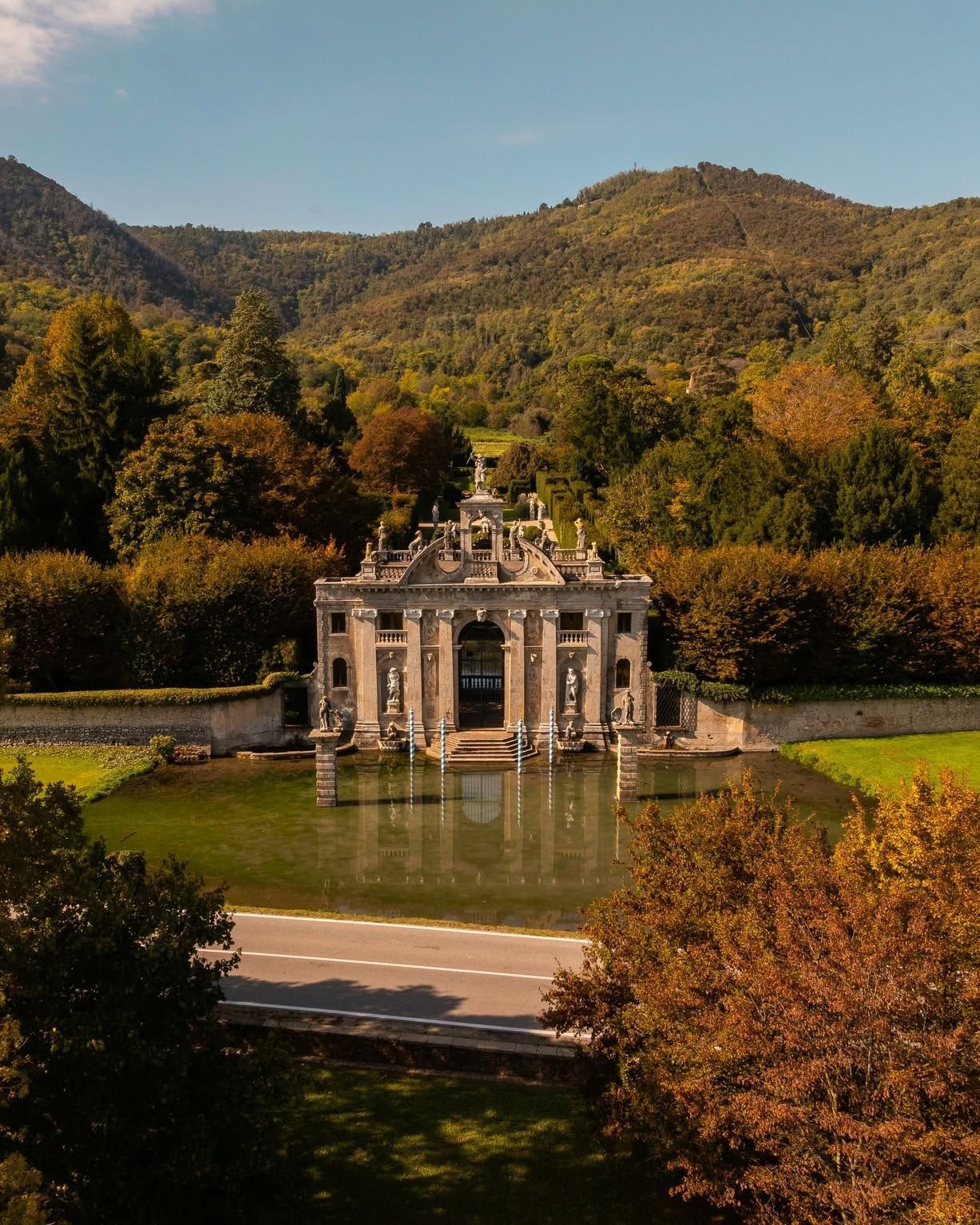
The Monumental Garden of Valsanzibio, in Veneto, takes the discourse towards a symbolic dimension. Here the garden works as a path, almost as a story to be crossed. Labyrinth, avenues, sculptures, water features, botanical garden and ancient stables construct a sequence in which every element seems to have a precise role.
It is one of the most interesting cases because it shows the garden as a narrative device. You do not visit it only to see plants or architecture, but to follow a mental itinerary. The labyrinth makes this idea clear: walking becomes part of the experience, and orientation becomes almost a theme. In summer Valsanzibio is a perfect choice for those seeking a more cultured, less immediate garden, where beauty also passes through play, symbol and the discipline of space.
7. Villa Cimbrone, Ravello
In Ravello, Villa Cimbrone is one of the most spectacular gardens of the Amalfi Coast. Its most famous image is the Terrace of Infinity, the belvedere suspended over the sea with busts looking out towards the horizon. It is one of those points where the landscape seems to become almost theatrical, built to carry the gaze to the limit.
The garden, however, does not live only on that view. There are avenues, statues, pergolas, shaded corners, sudden openings, green rooms and a continuous relationship between architecture and the Mediterranean. In summer Villa Cimbrone works because it transforms the verticality of the Coast into a slow experience. The sea remains enormous, distant and very close at the same time, while the garden constructs the rhythm with which to reach it.
8. Villa d’Este, Tivoli
Villa d’Este, in Tivoli, is the great classic finale. Declared a UNESCO World Heritage Site, it is one of the supreme examples of the Italian garden, built through fountains, nymphaeums, grottoes, terraces, water features and hydraulic music. Here the theme is very clear: water becomes architecture.
In summer Villa d’Este has an almost physical force. The sound of the fountains, the movement of the water, the sequence of terraces and the relationship with light transform the visit into something more intense than a simple stroll. It is a spectacular garden, designed to astonish, and precisely for this reason it continues to work. It does not seek only coolness. It constructs a scenography in which nature, technique and the desire for wonder hold together.
