
June 8th, 2026
Are stations becoming the new cultural billboards? With Art Station, Outdoora transforms some of Italy’s main railway hubs into places to be told about
For a long time, stations were considered places of transit. Spaces to pass through rather than observe, where everything seems built around urgency: catching a train, checking a platform, buying a coffee, waiting for someone, getting out as quickly as possible. And yet, precisely because of this fast-paced and everyday nature, stations have always been among the liveliest places in the city. Students, commuters, tourists, workers, people leaving, people returning, people waiting all pass through a station. It is one of the few urban spaces where very different audiences meet without necessarily belonging to the same context.
Today, this condition is becoming increasingly interesting for communication too. At a time when brands are everywhere, but are often remembered less and less, physical space is regaining enormous value. Not because digital has stopped working, but because on its own it is no longer enough. An online campaign can last for the length of a scroll, while an intervention in urban space carries a different weight, because it occupies a real place and intercepts people within a routine. It does not simply ask for attention: it encounters it.
Stations as urban stages
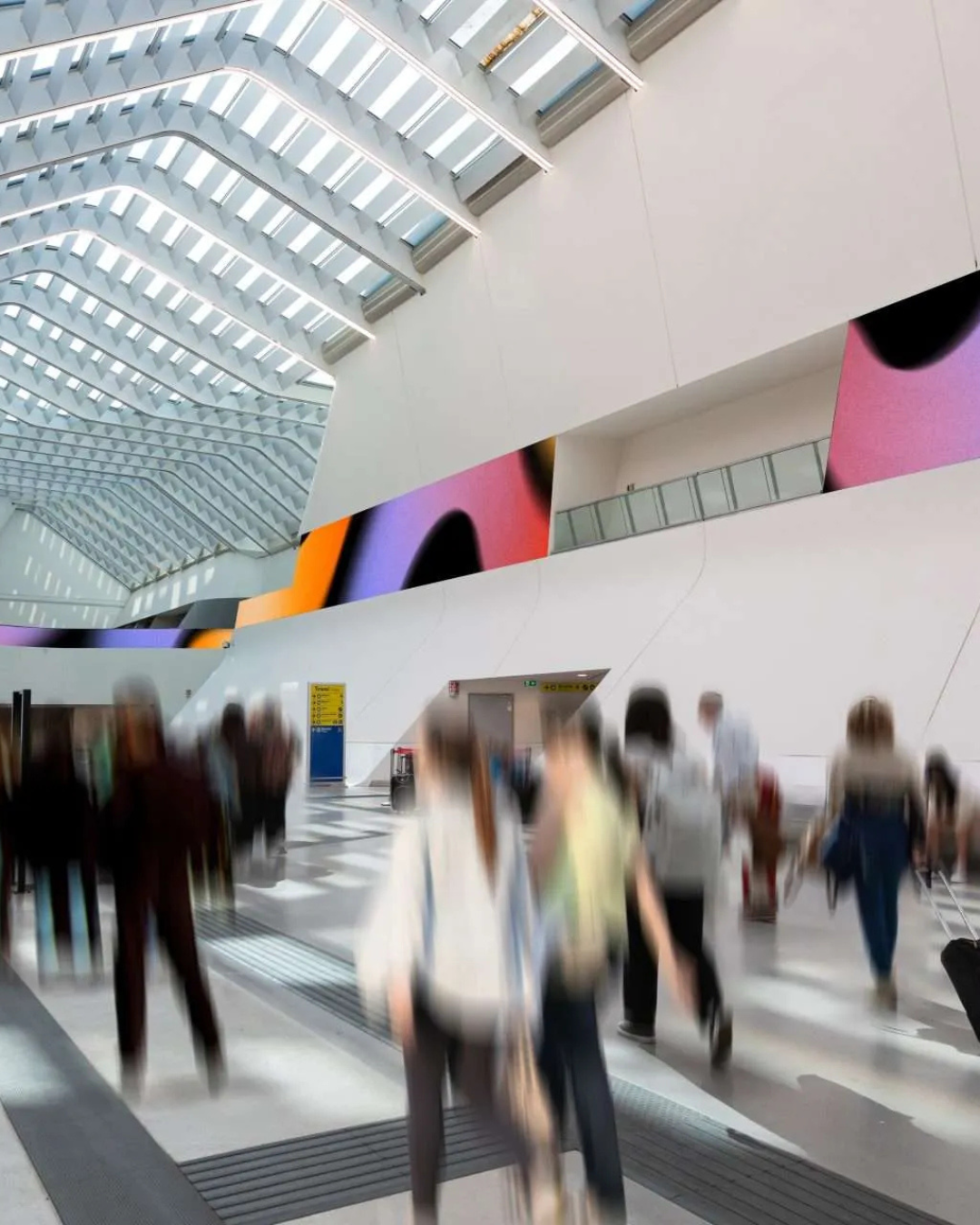
It is within this transformation that Art Station, the new media ecosystem presented by Outdoora, the urban creativity media company founded in Milan in 2023, takes shape. The project involves five high-speed railway hubs: Milan Porta Garibaldi, Turin Porta Susa, Padua Centrale, Rome Ostiense and Naples Afragola. Five stations that, thanks to the agreement with Altagares, part of the Altarea Group, have been granted under exclusive concession to Outdoora and become the centre of a project that does not aim merely to bring advertising into transit spaces, but to transform them into site-specific spaces where brands, Urban Art, territory and public architecture can engage in dialogue. According to the presentation document, these hubs will allow brands to communicate with more than 324 million contacts every year.
The difference is important. Because one thing is to use a station as an advertising surface; another is to try to read it as a cultural environment. Art Station starts precisely from this idea: the station is not a neutral support, but a place already full of meanings. There are people’s flows, waits, departures, encounters, façades, corridors, entrances and daily habits. Every station is a point of passage, but also a point of memory. We remember departures, returns, appointments, delays, journeys begun and journeys ended. If communication manages to enter these places without simply covering them, it can become something closer to an experience than to a simple message.
Filippo De Montis himself, Filippo De Montis, CEO of Outdoora, whom we had the pleasure of interviewing, sees Art Station as a platform capable of transforming stations into places of encounter, exchange and cultural ferment. Not only spaces crossed by millions of people, then, but accessible urban stages, where communication can become an active part of city life. According to this vision, the point is not to take a language born on the margins and use it as decoration for brands, but to create a space where that language can continue to express its original meaning, also through the involvement of artists and new generations.
Inhabiting a space
Outdoora in fact builds Art Station from a precise memory: that of Urban Art linked to trains and railway hubs. For decades, stations have been among the symbolic places of spontaneous creativity. Graffiti, tags, marks and unauthorised interventions have transformed carriages, walls and anonymous surfaces into tools of expression. Even before anyone spoke of urban creativity as a language that could be used by brands, trains were already moving media. They carried names, styles, codes and affiliations from one city to another. It was a form of irregular communication, often illegal, but culturally extremely powerful.
Today, that same energy is reimagined in a different, more structured and institutional form. And this is where the project becomes interesting, but also delicate. Because when a language born on the margins enters an official media ecosystem, the risk is always that it loses part of its original force. Urban Art can become decoration, atmosphere, a cool aesthetic used to make a campaign feel younger. But it can also become a way of recognising that those languages have already changed the way we look at the city, and that today they can no longer be treated as marginal elements.
This is precisely the central issue. Stations can become new cultural billboards, but we need to understand what that really means. If they simply become larger screens, then the change is only technical. If, instead, they become places where the message takes into account the architecture, the territory and the people who pass through them, then the conversation changes. Communication does not merely occupy a space, but tries to inhabit it.
The site-specificity of Art Station
In this sense, The Corner at Milan Porta Garibaldi is one of the clearest examples. With its 350 square metres of angled surface designed for 3D effects, the large LED wall on the station façade does not function only as an advertising installation, but as an urban scenic machine. Its strength lies not only in its size, but in its relationship with the context: the façade, the square, passers-by, travellers, and the continuous movement around the station. The same applies to The Dome at Turin Porta Susa, the largest OOH installation in the city, which transforms a transit space into a point of attention. In both cases, communication is not only an image to look at, but a presence that temporarily modifies the way we perceive a place.
Naturally, precisely because we are talking about spaces crossed by millions of people, the critical question cannot be avoided. If stations become new cultural billboards, who decides which culture enters these spaces? Which brands can afford to inhabit them? Which imaginaries are amplified and which are left out? This is not an automatic criticism, but a necessary question. Every time communication enters public space, it is not only selling something: it is modifying people’s visual landscape. It is helping to define what we see every day, which images accompany us, which idea of the city is staged.
This is exactly where the theme of limits comes in. For De Montis, the boundary between a memorable experience and an invasive presence lies in communication’s ability to become added value for urban space. A brand can enter a station only if it has a reason to exist in that specific place, if it dialogues with the territory, the public and the identity of the space. Otherwise, it remains only visual noise. The difference, therefore, is made not only by the technology or the size of the installation, but by its coherence with the context.
For this reason, the challenge for Art Station will be not to stop at impact. Impact is important, but it is not enough. The real difference will be played out in the ability to build projects that make sense in the places where they arrive. Milan Porta Garibaldi is not Turin Porta Susa, Rome Ostiense is not Naples Afragola, Padua Centrale is not just any station. Every place has its own identity, its own audience, its own relationship with the city. In Outdoora’s vision, Art Station must not become a format replicated everywhere in the same way, but a platform to be interpreted through the principle of site-specificity: every project is born from the territory and with the territory, involving artists, languages and themes capable of speaking to local communities.
Transforming media into place
Perhaps this is why stations are becoming so interesting for brands. Because they are not perfect, glossy or completely controllable places. They are real places, full of movement, noise, rush and unpredictability. And precisely for this reason, they are alive. In an age when many campaigns seem designed to look like experiences, stations already are experiences. They do not need to invent flow, audience, or the tension between waiting and movement. They only need to be read in the right way.
Art Station tries to move in this direction: transforming transit into experience, surface into narrative, media into place. Not as an alternative to digital, but as its complement. De Montis also underlines this: the media of the future will not have to choose between physical and digital, but learn to use one to feed the other. Physical experience creates empathy, participation and emotion; digital can amplify it, circulate it, and extend its relevance beyond the space in which it is born.
Stations can become the new cultural billboards not because they replace squares, museums or social media, but because they bring together something that is increasingly rare today: physical attention and collective presence. In a world where everything passes through a personal screen, public space becomes desirable again because it is shared, crossed, imperfect and alive. From this point of view, stations are no longer merely places to pass through. They are becoming places to read. And perhaps also to tell.
